1
‘History Of the Warwickshire Yeomanry Cavalry’
compiled by the
Hon. H.A. ADDERLEY (Lieutenant WYC).
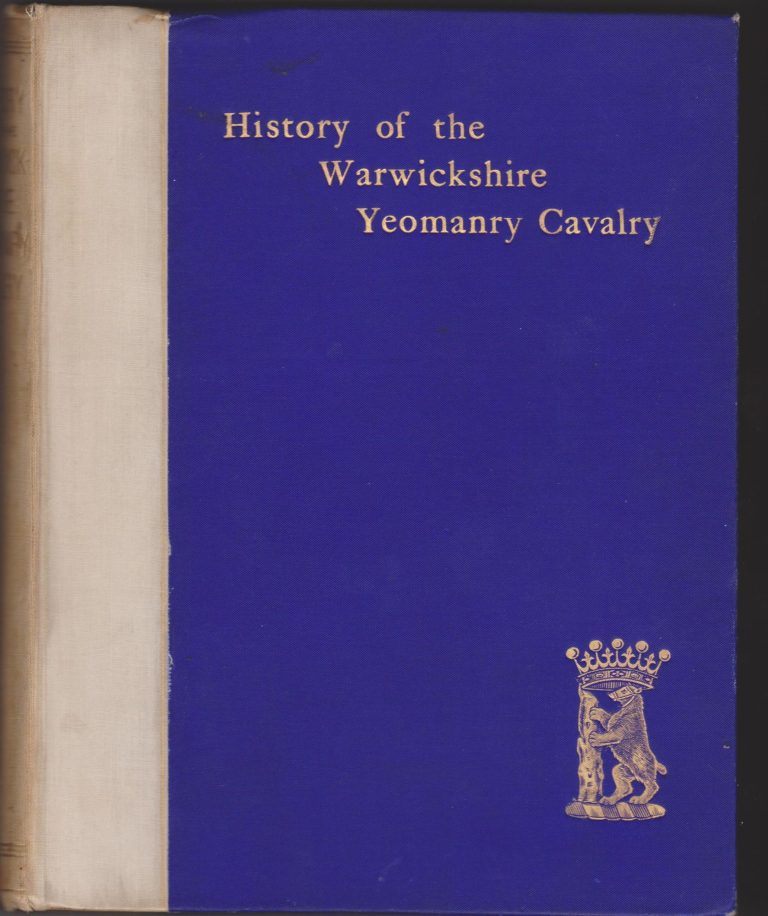
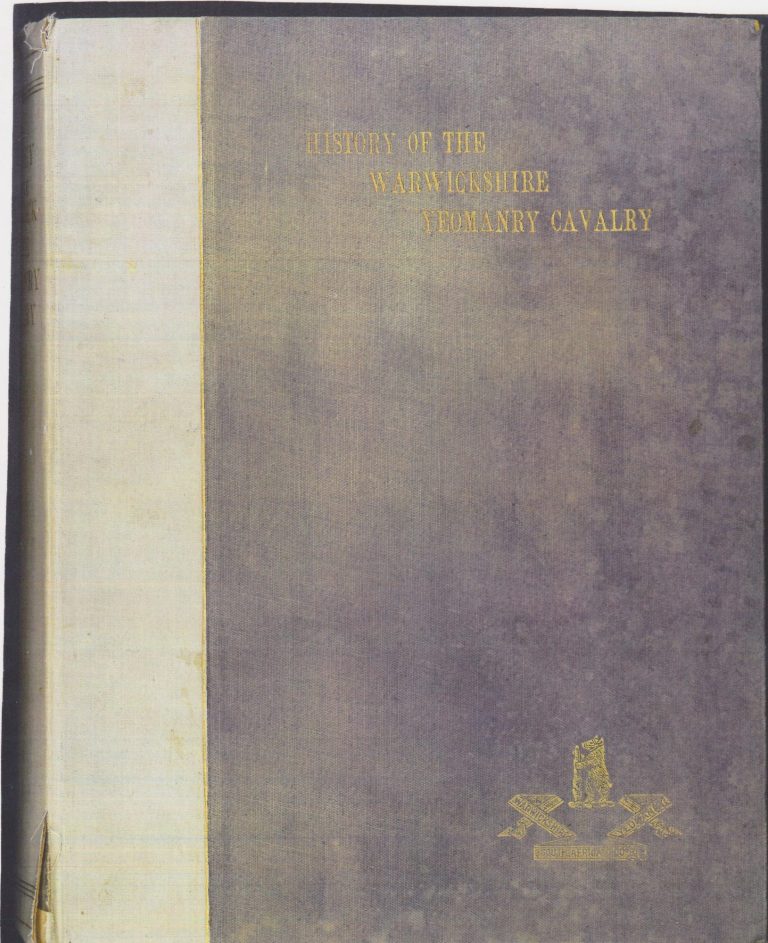
There are at least three versions of this book the first was published in 1896 which traces the history of the Regiment from its formation in 1794 to 1896, followed by an updated version published in 1912.
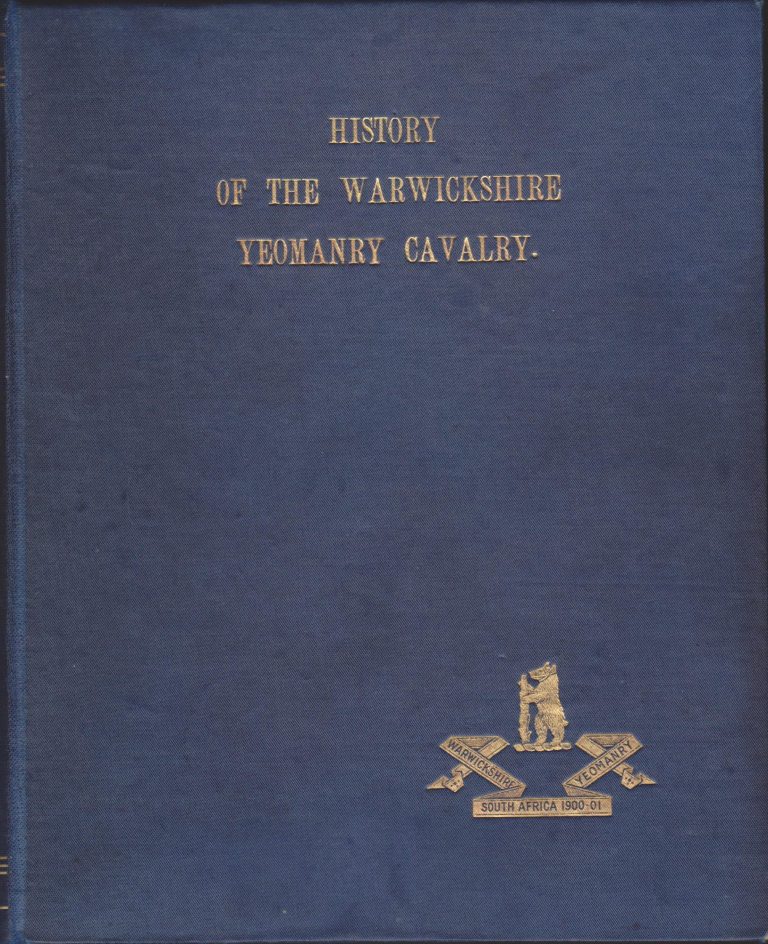
36 numbered copies of the De-Luxe 1912 version (larger print) were produced and signed by ADDERLEY.
These original books tend to command high prices in the second-hand book market and in more recent years ‘pirate copies’ or reprints have been produced in India and America at reasonable prices and they can be found in www.abebooks.co.uk
Back in the early 1970’s I purchased both the 1896 and 1912 versions from a local
antiquarian bookshop in Warwick and I have resisted the temptation to purchase the
De-Luxe large print 1912 version when offered.
Enclosed are images of these three books:
Image 1- The 1896 version with 13 illustrations. My copy was previously owned by Major Basil HANBURY who served with the Regiment from December 1864 to 1910,
Image 2 - The 1912 version with 16 illustrations. My copy has no book plate to indicate the previous owner.
Image 3 - The De Luxe large print version with 16 illustrations. This is a WkY Museum copy and is number 19 of 36 signed copies and was previously owned by Paul MORGAN.
We owe a debt of gratitude to ADDERLEY for compiling the 1896 and 1912 version which were subsequently indexed by Paul MORGAN in 1995.
2
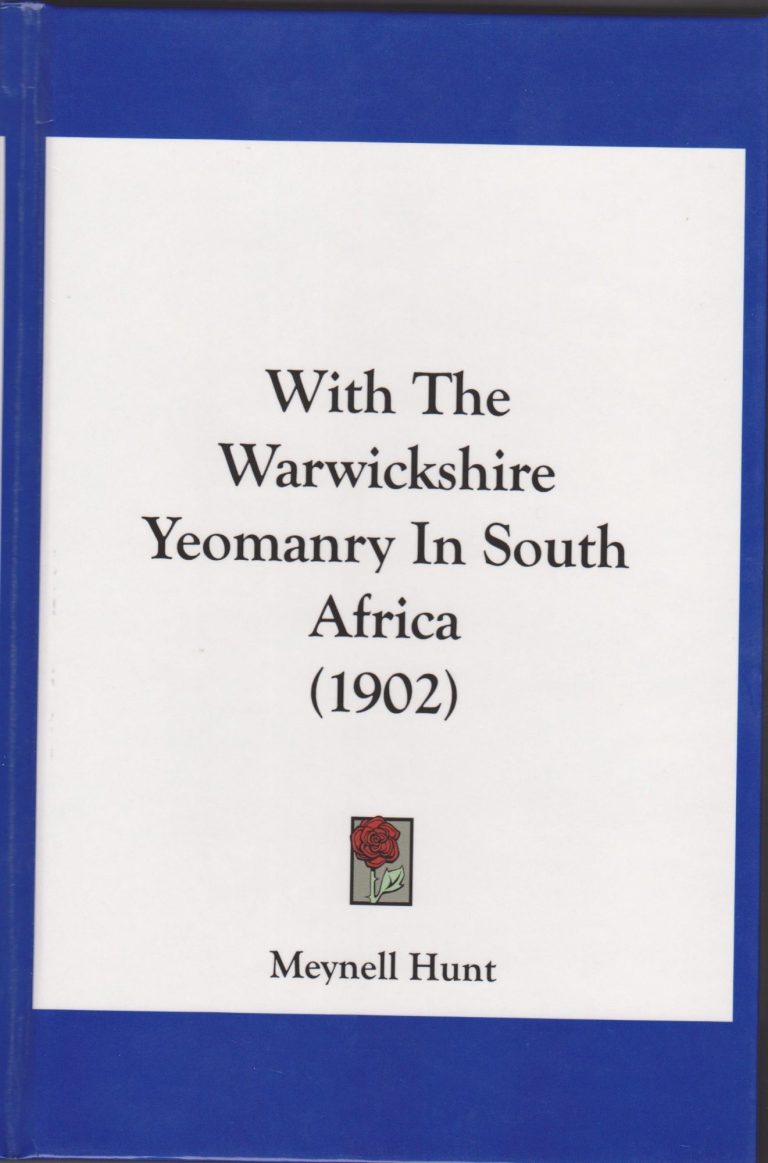
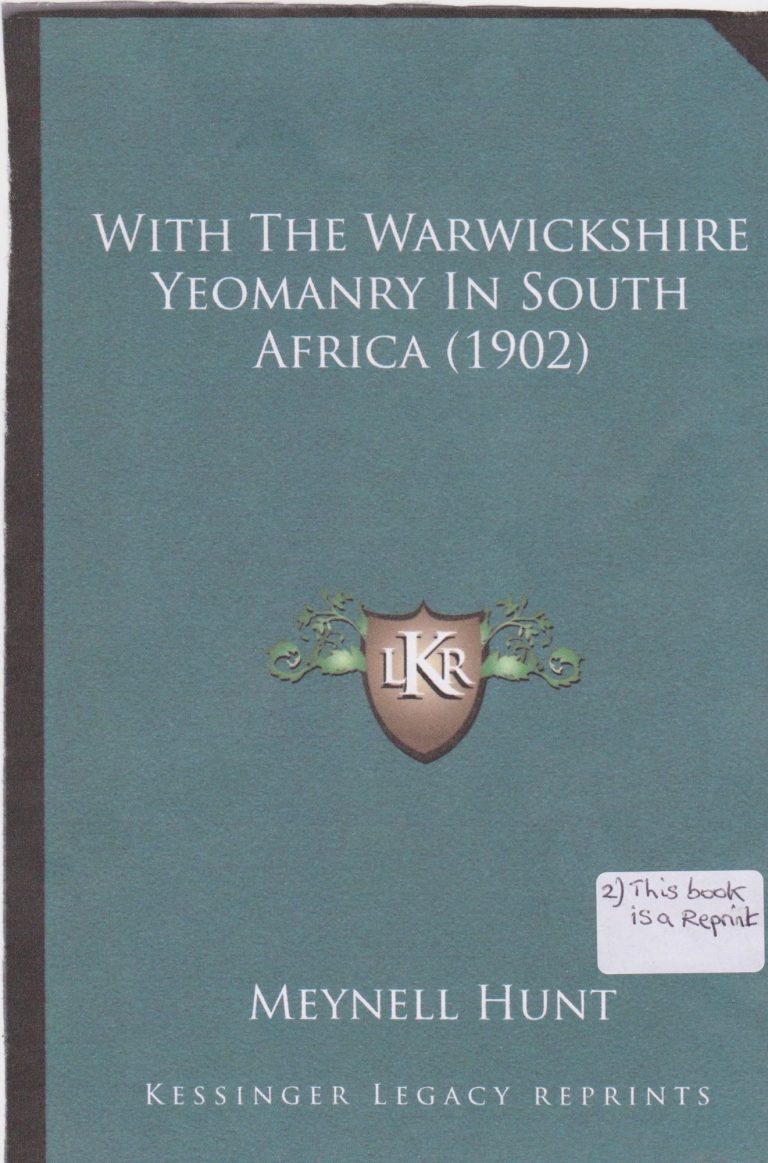
‘With the Warwickshire Yeomanry in South Africa’ by Meynell HUNT of the 5th Company (Warwickshire) 2nd Battalion Imperial Yeomanry from February 1900 to June 1901.
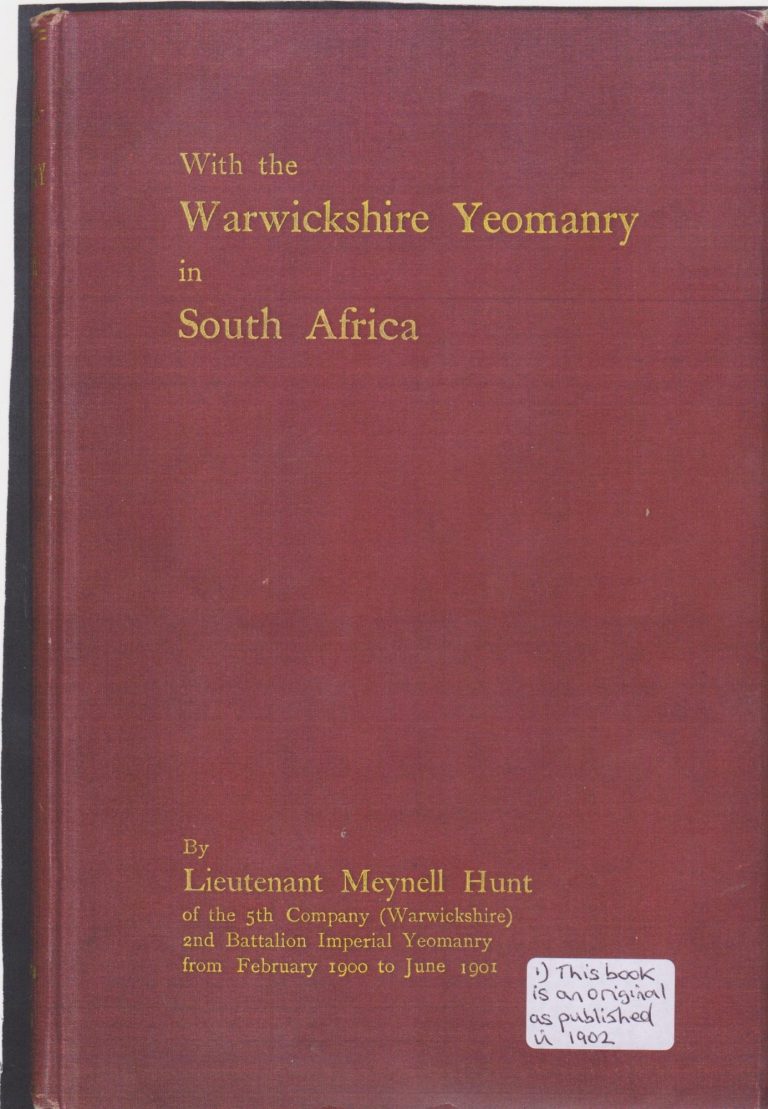
This book was first published in 1902 by Birmingham Cornish Brothers and provides a fairly detailed diarised
account, it includes the roll of those Warwickshire Imperial Yeoman who sailed from Liverpool on the ‘S.S. LAKE ERIE’ on 1st February 1900 for South Africa.
Original copies of this book are rare and are hard to find – we have an original copy in the Museum - see image left which includes a number of high-quality glossy photographs.
Sadly, this book does not include an index, but this was rectified by Paul MORGAN in 1995 making it that much easier to identify the involvement of individuals and places mentioned throughout the book by way of an indices.
Some years ago, I purchased a hard back reprint of this book published by KESSINGER Legacy Reprints. It’s effectively nothing more than a facsimile of the original except that the photographs have lost much of their sharpness and clarity, for they are not printed on glossy paper. See image of book with blue and white cover.
A paperback version of this book has recently been donated to the Museum Archive – see image of book with green cover and will prove most useful when responding to research enquiries.
Reprints of this book can also be found in India by way of print on demand and in the United States of America - see www.abebooks.co.uk
British Battles and Medals records that 137 men served with the 1st Contingent of Warwickshire Imperial Yeomanry in the 5th Company. The book does not cover the 136 men in the 2nd Contingent who served with the 103rd Company during 1902.
3
‘Warwickshire Yeomanry Cavalry’
compiled by the
Hon. H.A. ADDERLEY (Lieutenant WYC).
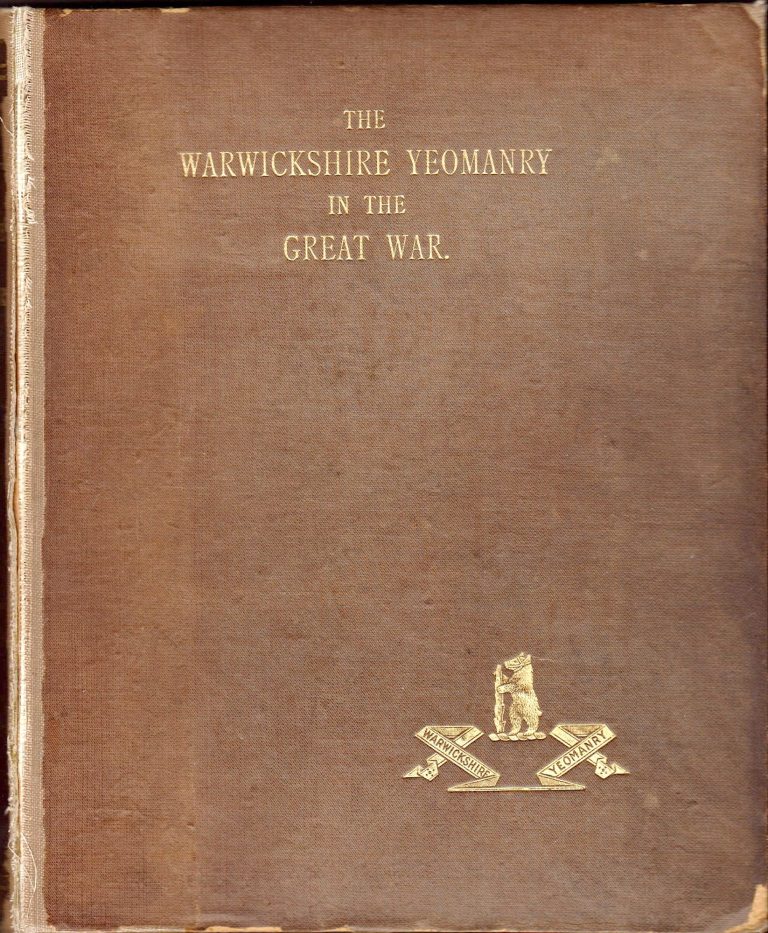
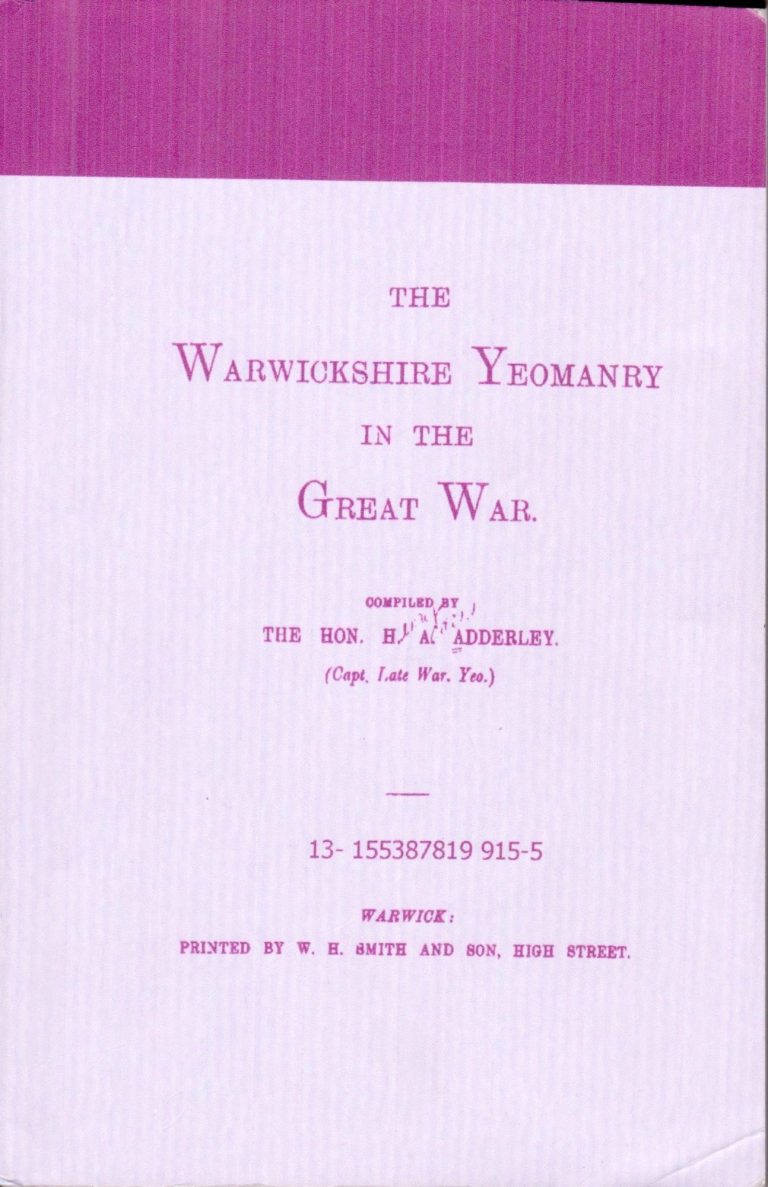
This book was published in May 1922 and is dedicated to those Comrades who gave their lives in the Great War 1914-1918.
ADDERLEY explains in the Preface that many important documents, which would have been invaluable had been lost at sea during the War, but letters and diaries full of
interesting information were supplied by which with the help of Official Despatches and War Histories he put together a narrative of events in which the Regiment was concerned.
The sources of information are mentioned in the preface to this exceptionally good book which he hoped would provide a fairly reliable record for posterity, and we shall come back in subsequent posts. ADDERLEY acknowledged that there might well be errors but he stuck to the facts and avoided controversy in so doing he produced a good Regimental History for the Great War.
Each chapter comprises a period mainly within the dates specified in the heading and is introduced by a short outline of the particular phase of operations, obtained either by a precis of despatches, or by extracts from publications on the War and these are listed in the Preface. Casualties are listed by name and date within specified periods for the 1/1st Warwickshire Yeomanry. Chapter Seven provides a useful synopsis of the Reserve Units raised during the War, namely the 2/1st and 3/1st Warwickshire Yeomanry.
There are two Appendices:
Appendix 1. List of Officers of the Regiment 1914 to 1918. Commissions, Services and Appointments.
Appendix 2. List of Honours and Awards.
The book includes 17 photographs, 1 sketch, 4 maps and the Diagram of Attack at HUJ. In recent years reprints of this book have been published in India – these are effectively
facsimiles; the quality of the pictures and maps are not as good as those in the original book.
The Museum Trustees are indebted to Paul MORGAN who compiled an index to this book in 1995 which has proved exceptionally useful as a first reference point when responding to research enquiries.
Observation
Item 1. My copy purchased in 1970 – the book plate indicates that it was previously owned by Henry Burton TATE who served with Regiment from 15.2.13. 2nd Lieut. being promoted to Lieut. on 11.12.14.
Item 2. My copy of a paperback version by way of reprint, published in India.
4
‘Yeoman Yeoman’ by Paul BAKER.
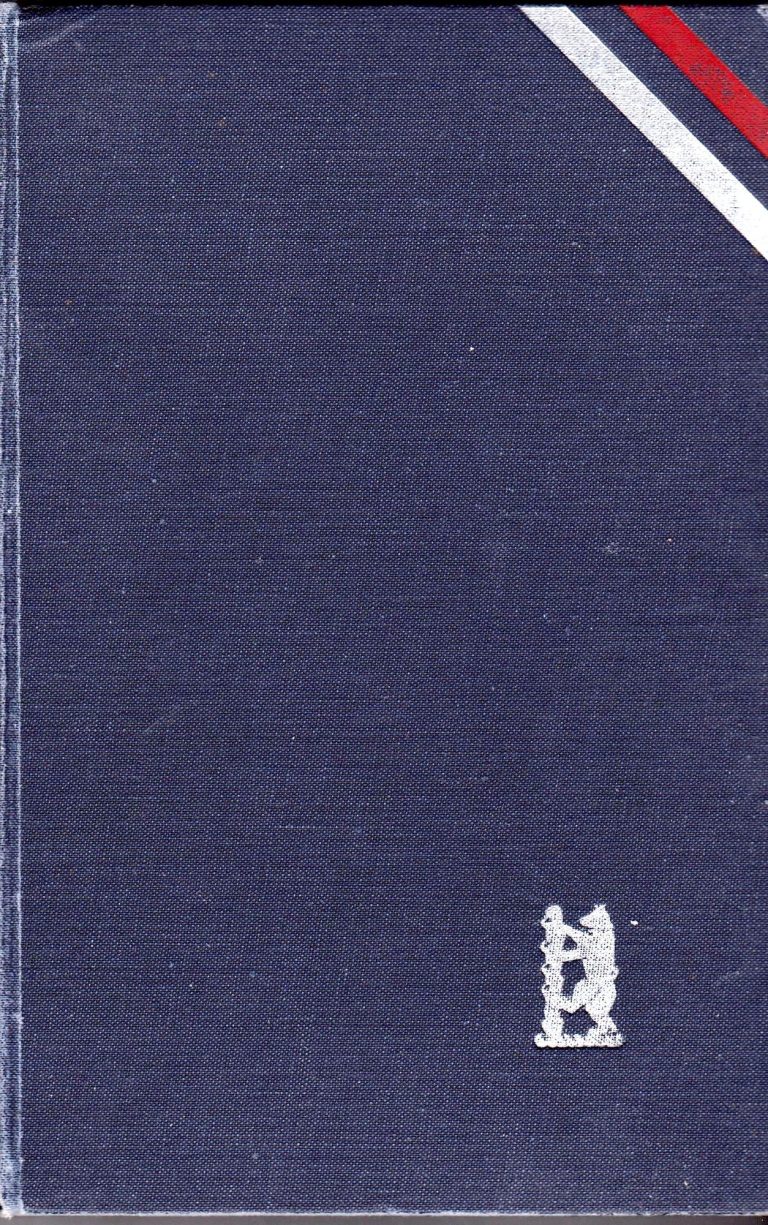
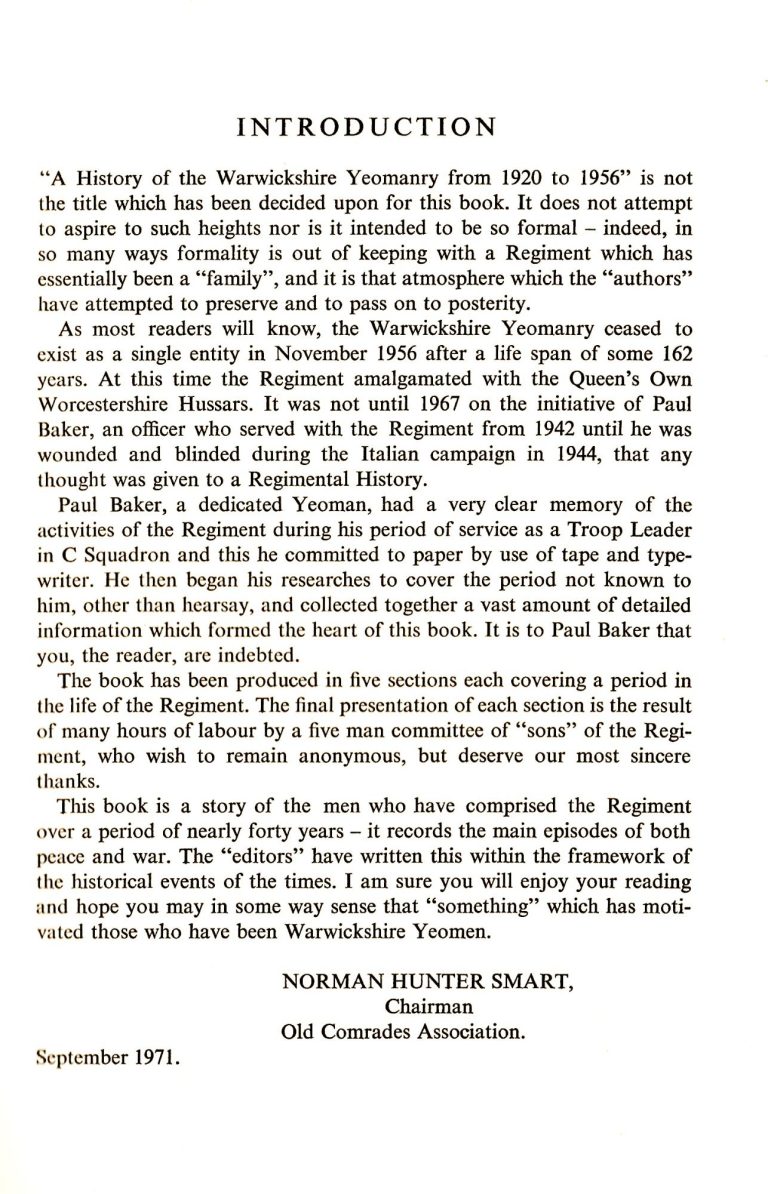
This book was published in October 1971 see enclosed
‘Introduction’ to this book for as explained it does not
aspire to be a complete history of the Regiment during the period 1920 to 1956, however it does provide a fascinating insight into the life and experiences of those who served during WW2 with the Warwickshire Yeomanry.
There are 35 photographs, many evoking memories of the three phases of the Regiment during WW2: Horses, Trucks and Tanks.
There are seven maps and five Appendices:
Appendix A - Honours and Awards.
Appendix B - Roll of Honour those Killed in Action.
Appendix C - Wounded in Action.
Appendix D - Prisoners of War.
Appendix E - List of Abbreviations (for those not familiar with them)
This is an exceptionally good book and is well worth reading - original copies occasionally turn up in www.abebooks.co.uk
The Museum Trustees are indebted to Paul MORGAN who compiled an index to this book in 1995 which has proved exceptionally useful as a first reference point when responding to research enquiries.
Observation
My copy of this book which I purchased in 1971 has long since lost its book cover.
5
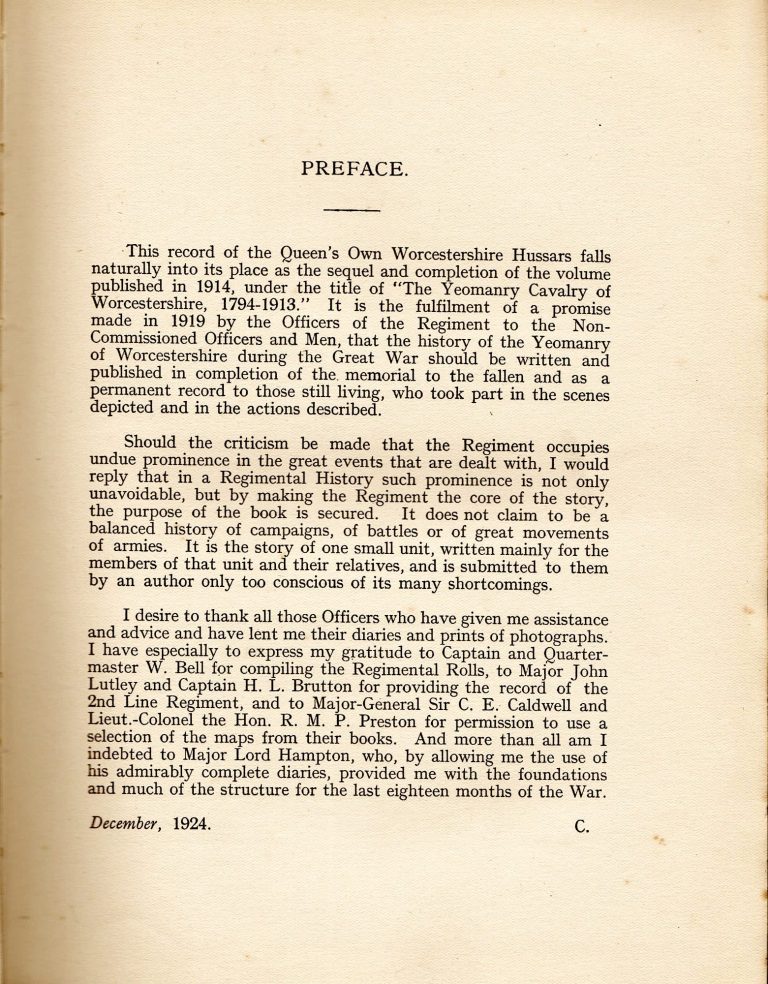
‘The Yeomanry Cavalry of Worcestershire
1914-1922’ by C.
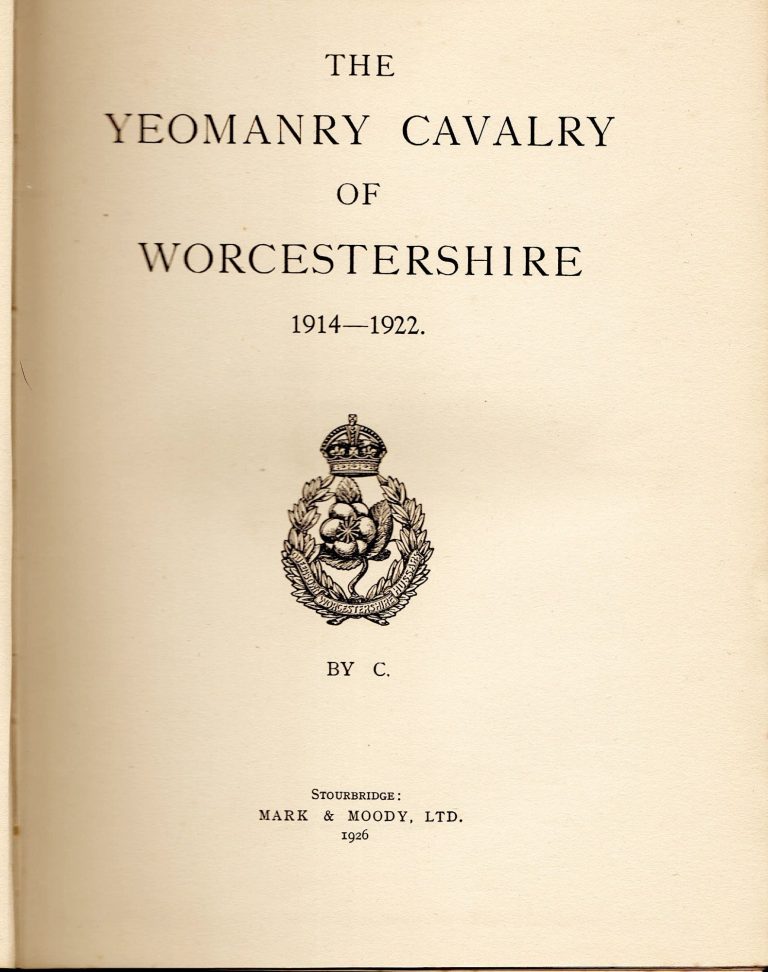
This book was published in 1926 and is dedicated to
‘The Yeoman of Worcestershire Who Laid Down Their Lives 1914-1918.’
As explained in the enclosed preface it is a sequel to ‘The Yeomanry Cavalry of Worcestershire, 1794-1913’ published in 1913. The use of diarised dates throughout the book
enables the reader to evaluate the narrative and see what transpired alongside other printed material for the same date during 1914-18.
The book contains 18 photographs, 14 maps and two appendices.
Appendix A. Record of the 2/1st Worcestershire Yeomanry
Appendix B. Nominal Roll of the 1/1st Worcestershire Yeomanry and the Rolls of subsequent Drafts.
On Mobilisation in August 1914 the Warwickshire, Worcestershire and Gloucestershire Yeomanry’s formed the 1st South Midland Mounted Brigade and later the 5th Mounted Brigade serving with distinction in the Sinai and Palestine.
In March 1918 the Warwickshire Yeomanry was selected for dismounted service as Machine Gunners in France on the Western Front. They parted company with the Worcesters and Gloucesters at a mounted parade on 1st April 1918. ‘The memories of Suvla Bay, and Romani, Rafa and Gaza, and the bloody brotherhood of Huj, provide an
unbreakable chain’ binding together both the Warwickshire Yeomanry and the Worcestershire Yeomanry.
Observation
I purchased this books for my private collection back in the 1980s from an Antiquarian Book dealer at the Stratford Medal Fair. They have proved to be a good investment for they rarely turn up in the second-hand book market and when they do they command high prices.
6
‘The Standing Orders of the Warwickshire Yeomanry’ (1912) by
Lieut. Colonel F. DUGDALE, C.V.O., T.D,
Commanding Warwickshire Yeomanry.
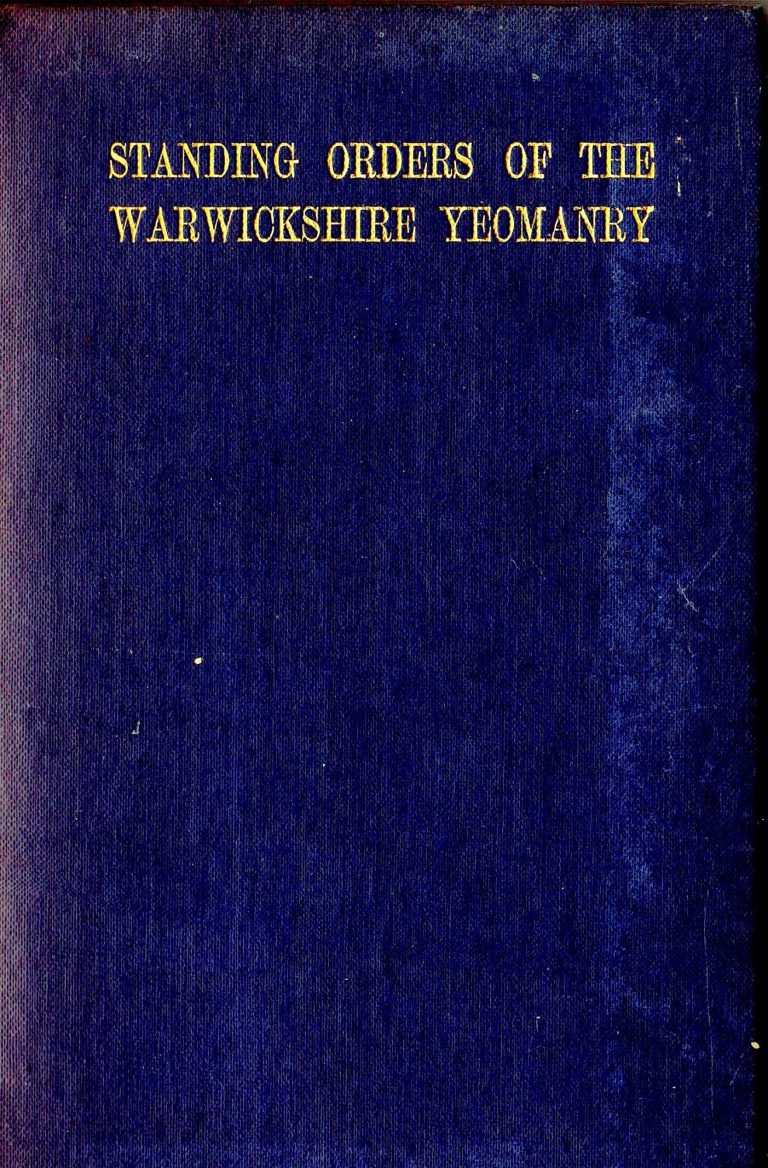
This book was published in 1912 and was compiled by the Adjutant of the Warwickshire Yeomanry,
Captain T.H.S. MARCHANT (13th Hussars).
The expectation being that ‘Every Officer, NCO and man in the Regiment will have in his possession a copy of these Regimental Standing Orders.’
The book is very thorough covering all aspects of the Regiment’s operating procedures.
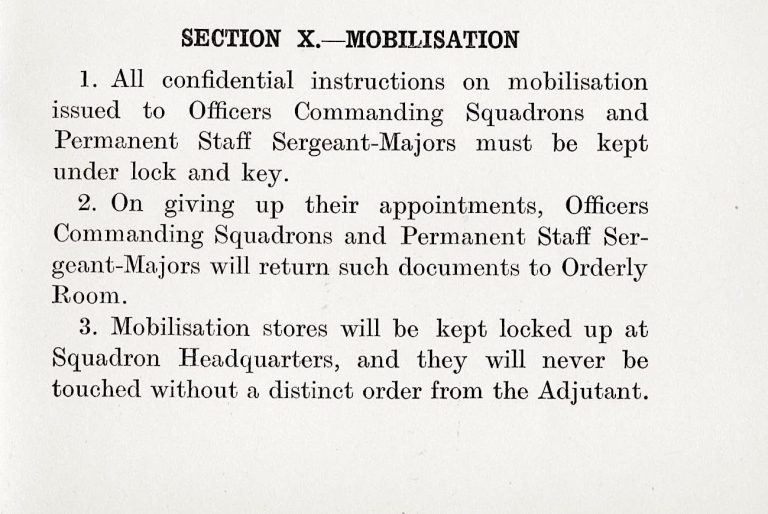
By way of example below are the details re Mobilisation (pages 47 & 48).
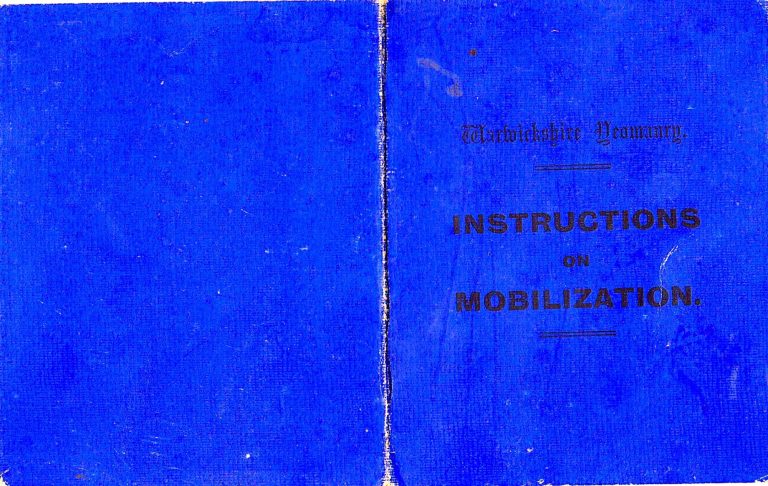
Your attention is drawn to the requirement that every man in the Regiment must have in his possession a copy of ’Instructions on Receipt of Orders to Mobilise’ – see blue card.
Clearly the work done in 1911 to update and compile these procedures coupled with
exceptionally good training enabled the Warwickshire Yeomanry to commence mobilising on 4th August 1914. All four Squadrons are in Warwick by 10th August, complete with horses, entraining at Milverton for Bury St Edmunds on the 13th August 1914.
Observation
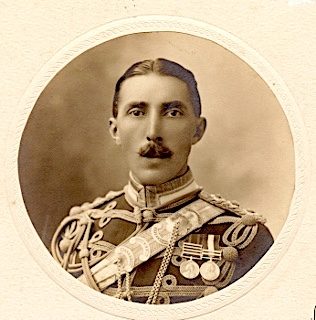
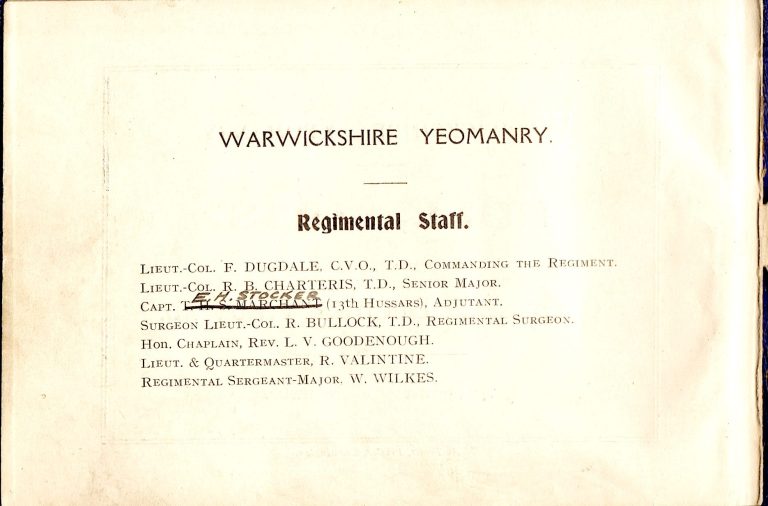
Captain T.H.S. MARCHANT, 13th Hussars was the Adjutant of the Warwickshire Yeomanry from September 1909 to Sept 1913. He retired from the Army with the rank of
Brigadier-General in 1925.
For more than 17 years before his final retirement in 1947 he was the Secretary of the Institute of the Horse and Pony Club. During the period 1940-42 MARCHANT was Officer Commanding 2nd County of London Bn, Home Guard.
Truly a remarkable man whose pastel portrait is to be found in the Warwickshire Yeomanry Museum.
7
‘Warwickshire Yeomanry Pocket Book’
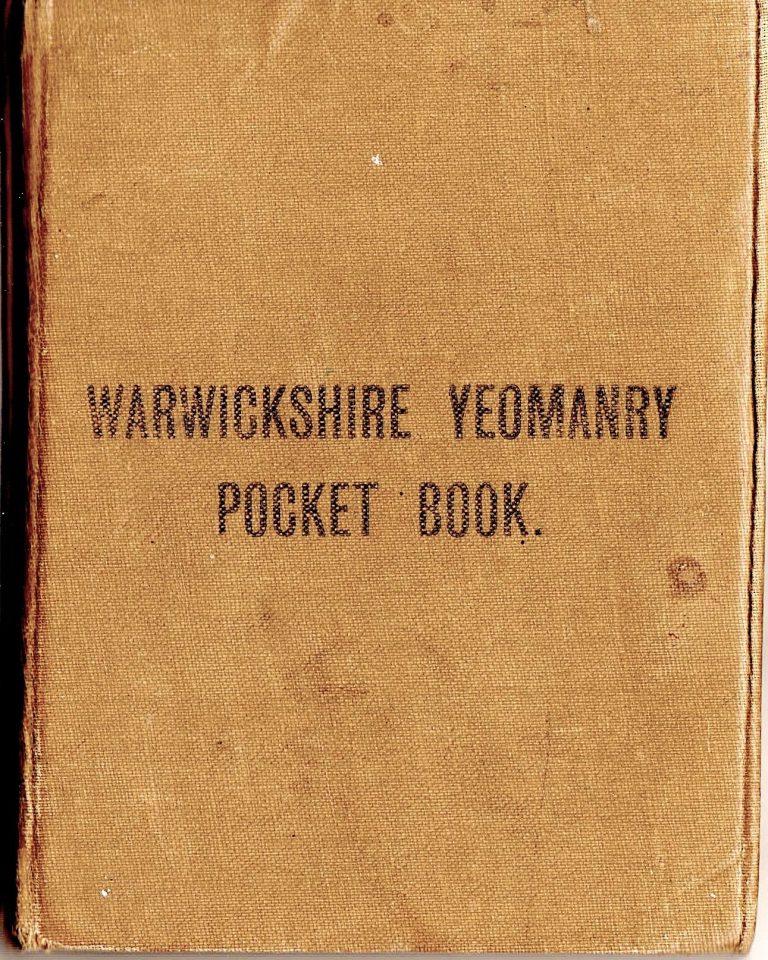
This book was published on 1 November 1911 followed by a reprint on 1 March 1914. The book has a fold over flap to protect contents
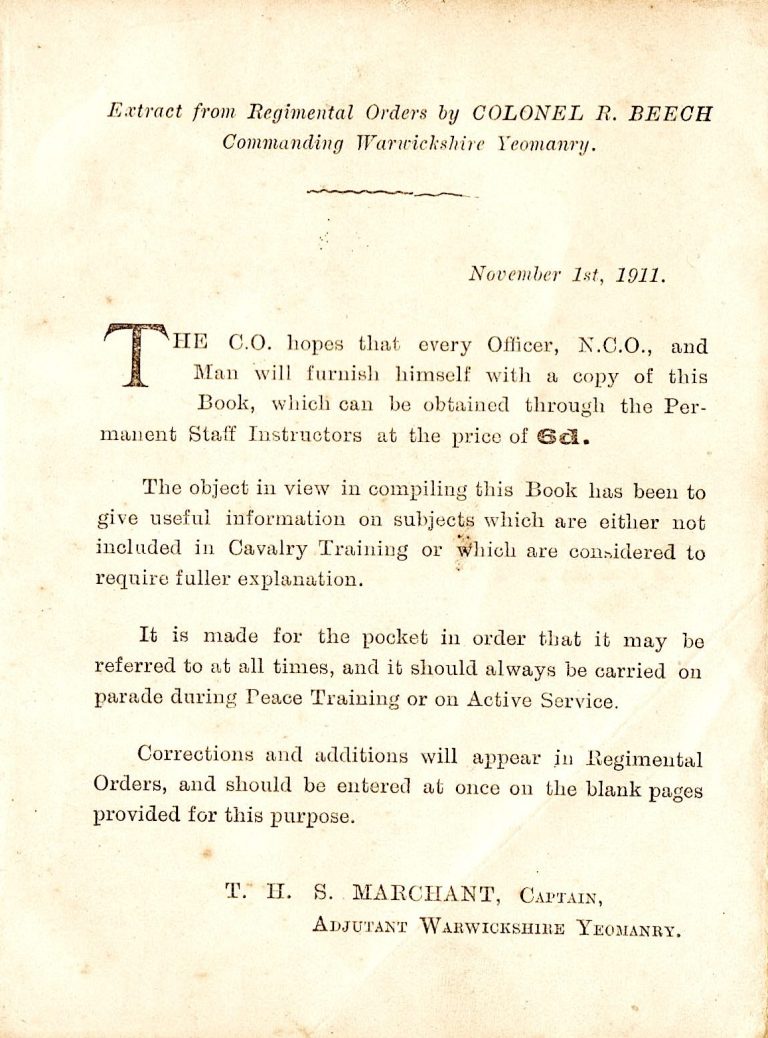
The requirement being that every Officer, N.C.O. and Man would furnish themselves with a copy for 6d (sixpence old money) and that it should always be carried on parade
during Peacetime Training or on Active Service.
Corrections and additions appeared in Regimental Orders and should be entered on the blank pages provided for this purpose in the book.
Enclosed is the Preface to the book issued by Captain T.H.S. MARCHANT, Adjutant Warwickshire Yeomanry, which explains the purpose of this book together with the Contents Pages.
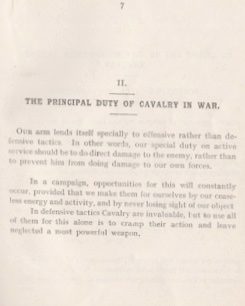
Also enclosed is the page relating to ‘The Principal Duty of Cavalry in War.’
The 1914 Reprint was issued by Captain E.H. STOCKER, Adjutant, Warwickshire Yeomanry on 1st March 1914.
Observation
This Pocket Book provides a fascinating insight into the role of Cavalry and their training for ‘Surprise is the greatest of all foes.’
8
‘The Warwickshire Yeomanry in the Nineteenth Century: Some Fresh Aspects - With a Transcript of the three surviving Troop Rolls.’
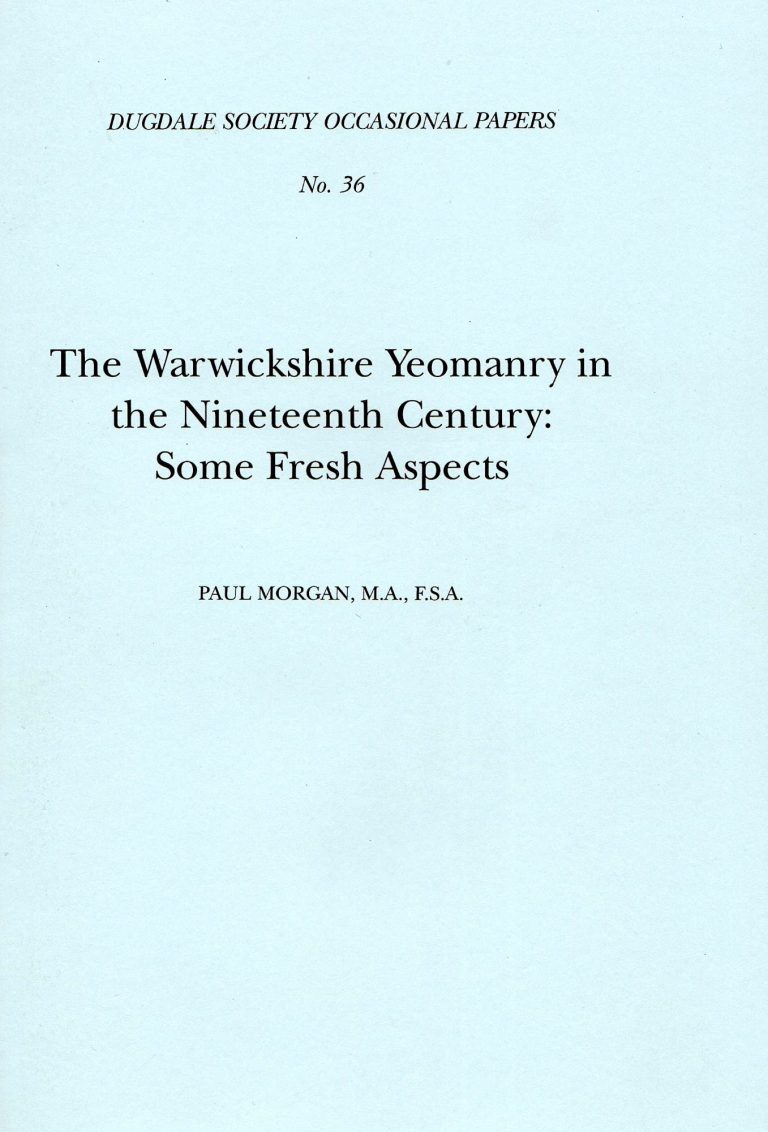
Booklet No.36 in the DUGDALE Society Occasional Papers was compiled by Paul MORGAN in 1994 to coincide with the 200th Anniversary of the formation of the Warwickshire Yeomanry Cavalry.
This seventy nine page booklet provides a fascinating glimpse into different aspects and personalities within the Regiment since its formation on 25 June 1794 ‘when it was resolved to raise a Corps of Yeomanry Cavalry of four Troops of 54 men, including Officers’ [1]
By the 1831 the Regiment had six Troops and ‘from the Parliamentary Return of that year both Warwickshire and Staffordshire were allowed to be kept up to their full strength, at this time the former had a total of 427, including Officers.’ [2]
In 1895 the Regiment consisted of eight Troops and was ordered to stand in Four Squadrons. [3]
Regrettably only three Troop Rolls are known to have survived covering the periods as specified and these together with the Articles of Enrolment have been transcribed and
reproduced in this booklet:
The Roll of First Troop of the Warwickshire Yeomanry commonly called the Vellum Roll c.1836-1868. (Warwickshire Yeomanry Museum)
The Roll of the Second Troop of the Warwickshire Yeomanry c.1836-1895.
(Warwickshire Yeomanry Museum)
The Roll of the Sixth Troop of the Warwickshire Yeomanry 1852-1868 (Shakespeare Birthplace Trust)
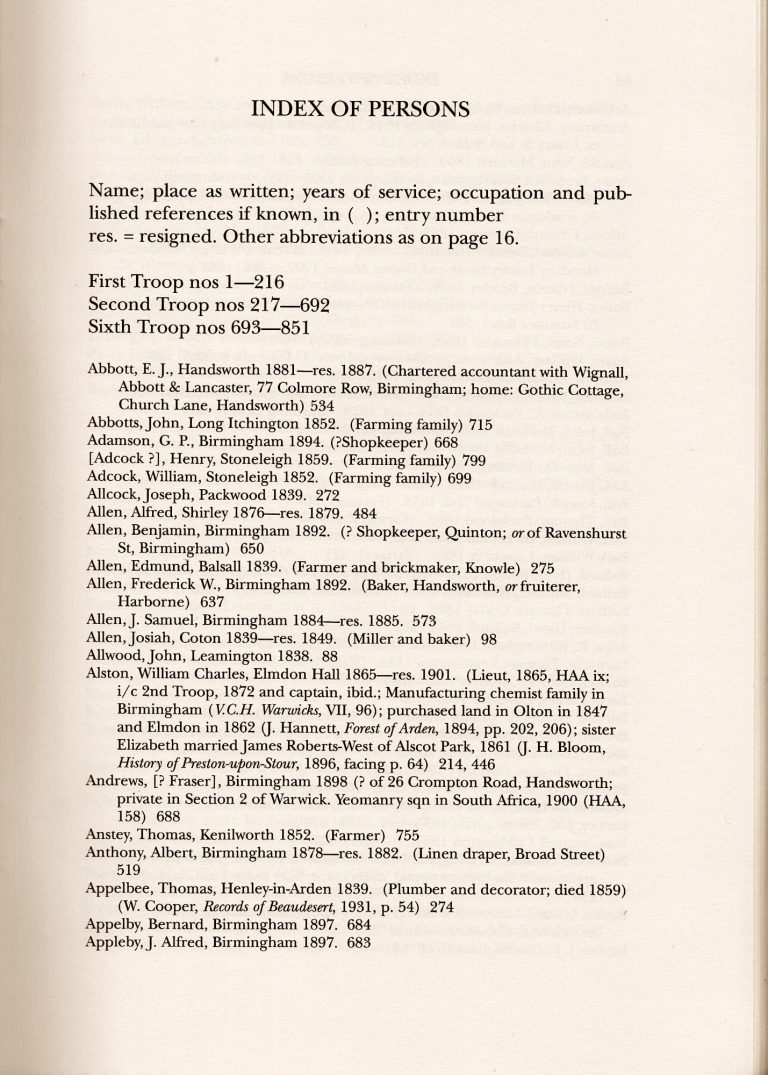
This booklet includes a most useful Index of Persons (23 pages).
The first page of this index is enclosed - the level of detail is exceptionally good.
There is also an Index of places mentioned within the above three Rolls.
[1] See page 10 ‘History of the Warwickshire Yeomanry Cavalry’ by ADDERLEY.
[2] See pages 50 & 51 ‘History of the Warwickshire Yeomanry Cavalry’ by ADDERLEY.
[3] See page 142 ‘History of the Warwickshire Yeomanry Cavalry’ by ADDERLEY.
Observation
The whereabouts of the missing Troop Rolls remains a mystery to this day.
9
‘Warwickshire Imperial Yeomanry Roll of ‘’A or Major J.D. MILLS Squadron‘ (undated)
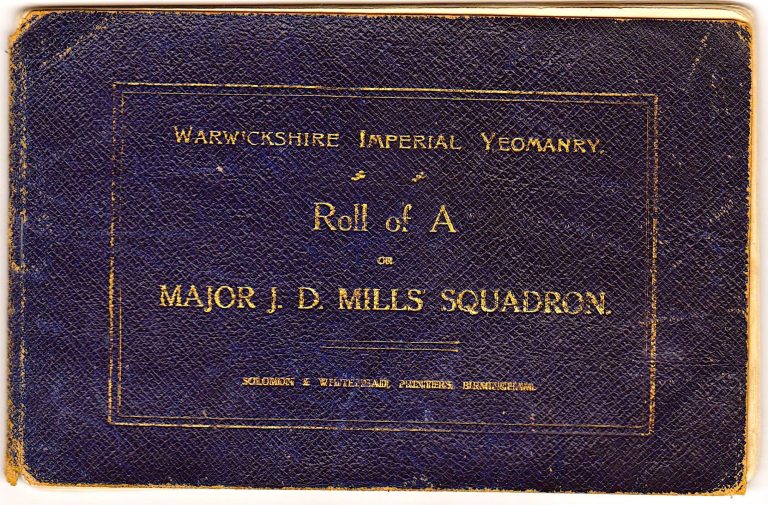
This fifteen-page booklet was published in April 1911 and provides the names of four Officers in ‘A’ Squadron together with their home addresses:
Major J.D. MILLS
Captain Lord GUERNSEY *
Lieutenant R.S. WILSON
and 2nd Lieutenant L.B. JOYNSON **
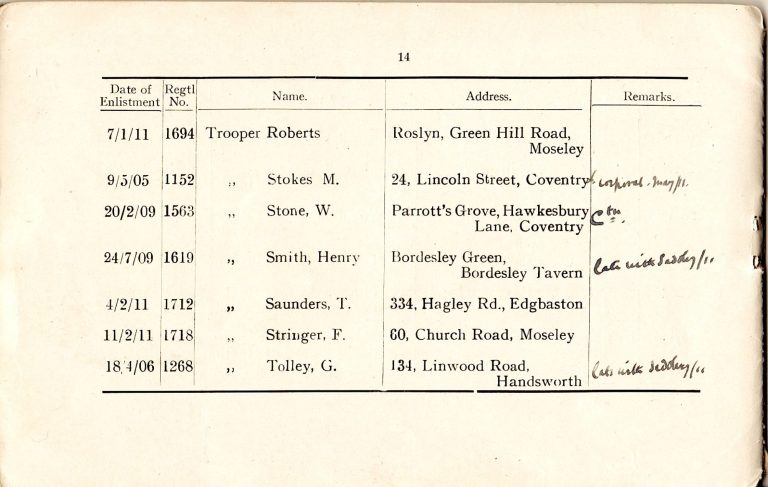
The booklet provides the following details for 90 enlisted men serving in ‘A’ Squadron, Warwickshire Yeomanry, Birmingham:
Date of enlistment
Regimental Number
Rank
Name and Initials
Home address
Remarks
One page of enlisted men is enclosed by way of example.
The last man to join the Squadron prior to this booklet being published was 1718 Trooper
F. STRINGER - he enlisted on 11 February 1911 and served with the Regiment during WW1.
This copy of the ‘A’ Squadron 1911 Roll in the Museum Archive includes ink annotations, for it was used to compile the ‘Warwickshire Yeomanry Roll of ‘A’ Squadron commanded by Major J.D. MILLS 1912.’ The annotations on several pages of the booklet indicate that some men were late with their saddlery.
Unfortunately, we do not have a complete run of Squadron Rolls in the Museum for the period 1900 to 1912. Those Rolls we do have are most useful indeed when responding to research enquires.
Observation
Captain Lord GUERNSEY *(Lieut. late Irish Guards), Capt. 17 August 1910, re-joined Irish Guards August 1914, k-in-a France (Battle of Aisne, 14 Sept 1914.
L.B. JOYNSON MC * Lieut. 10 Feb 1912, Captain 7 January 1916, seconded as Brigade Signalling Officer, mentioned in despatches.
10
‘Warwickshire Yeomanry Roll of ‘A’ Squadron-Commanded by Major J.D. MILLS 1912.’
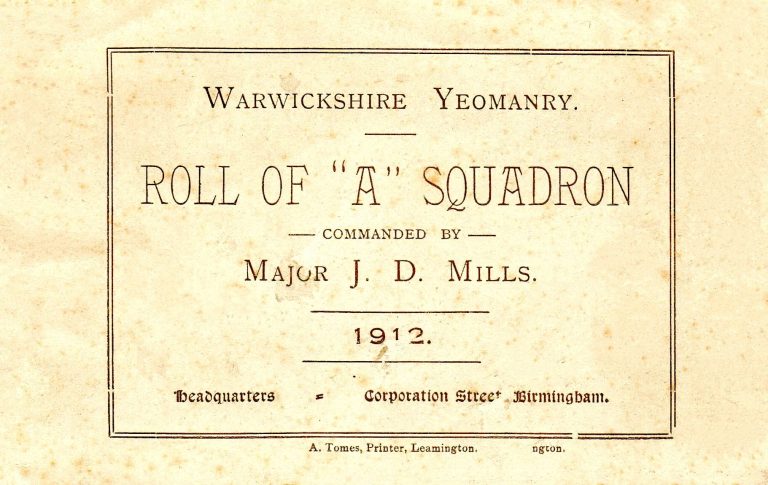
This fifteen-page booklet was published in late April 1912.
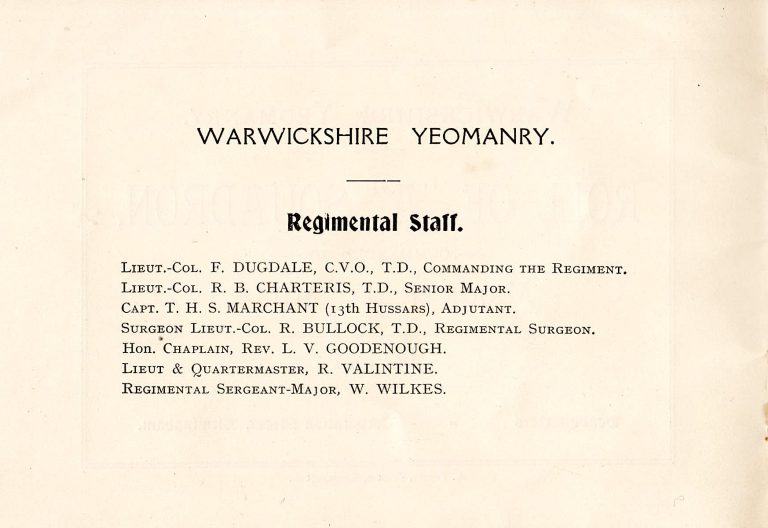
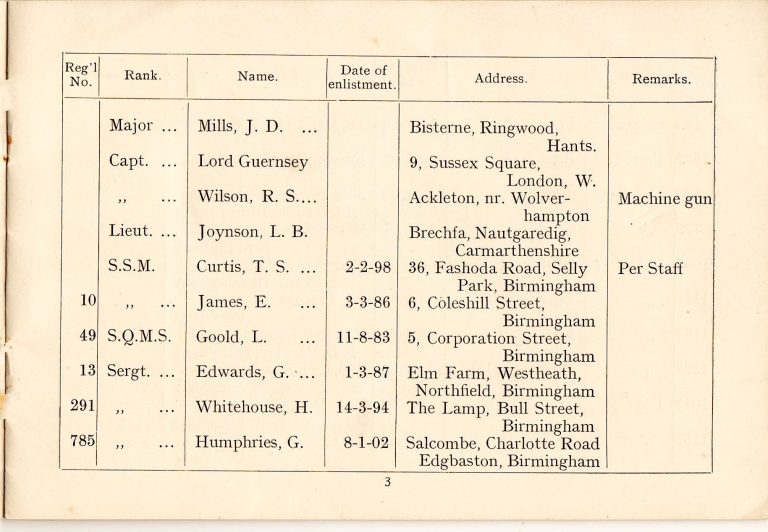
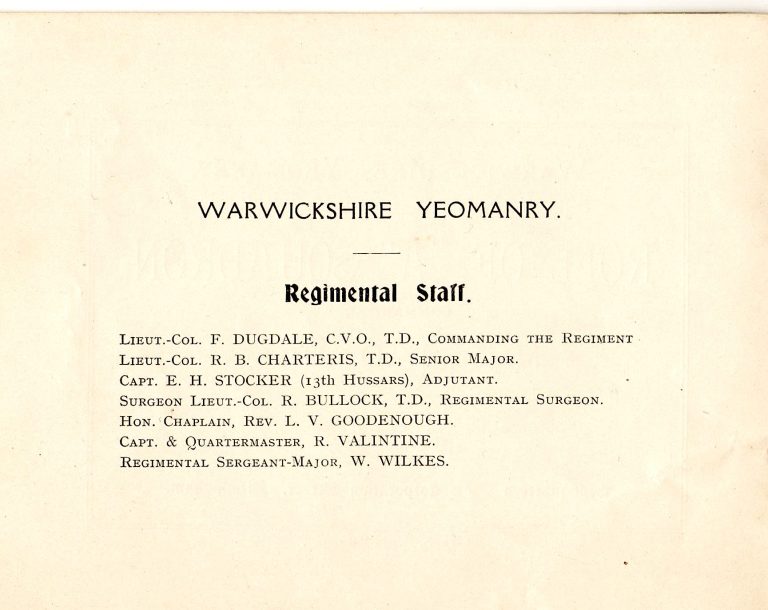
It lists the Regimental Staff on page 2 (see enclosure) and provides the names of the four Officers in ‘A’ Squadron
together with their home addresses on page 3:
Major J.D. MILLS
Captain Lord GUERNSEY *
Captain R.S. WILSON
and Lieutenant L.B. JOYNSON **
The booklet provides the following details for 103 enlisted men serving in ‘A’ Squadron, Warwickshire Yeomanry, Birmingham, compared with 90 men in the 1911 booklet:
Date of enlistment
Regimental Number
Rank
Name and Initials
Home address
Remarks
The last man to join ‘A’ Squadron prior to this booklet being published was:
1879 Pte H.O. COTTERILL who enlisted on 10 April 1912 and had the misfortune to be killed in action at Gallipoli on 10 September 1915.
There are twenty-two men listed as Recruits - 9 men having left the Squadron during the twelvemonth period ended 10 April 1912. Troopers in the 1911 version are now listed as Privates.
Unfortunately, we do not have a complete run of printed Squadron Rolls covering the
period 1900 to 1912 in the Museum Archive. Those Rolls we do have continue to prove most useful when responding to research enquires.
Observation :
Captain Lord GUERNSEY *(Lieut. late Irish Guards), Capt. 17 August 1910, re-joined Irish Guards August 1914, KIA France (Battle of Aisne, 14 Sept 1914.
L.B. JOYNSON MC * Lieut. 10 Feb 1912, Captain 7 January 1916, seconded as Brigade Signalling Officer, mentioned in despatches.
11
‘Warwickshire Yeomanry Roll of ‘A’ Squadron-Commanded by Major J.D. MILLS 1913.’
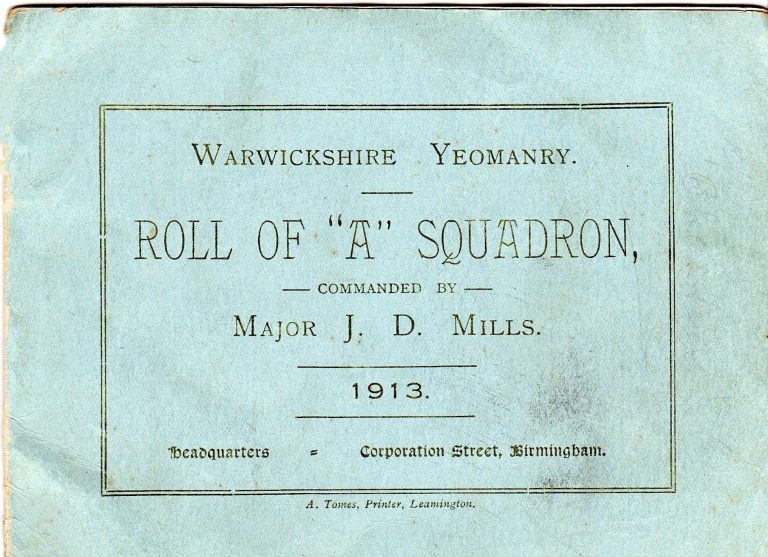
This fifteen-page booklet was published in April 1913. It lists the Regimental Staff on page 2 and provides the names of the five Officers in ‘A’ Squadron together with their home addresses on page 3:
Major J.D. MILLS
Captain Lord GUERNSEY *
Captain R.S. WILSON
Lieutenant L.B. JOYNSON
and 2nd Lieutenant G.A. LLOYD (commissioned 8.6.1912) ***
The booklet provides the following details for 106 enlisted men serving in ‘A’ Squadron, Warwickshire Yeomanry, Birmingham, compared with 103 men in the 1912 booklet:
Date of enlistment
Regimental Number
Rank
Name and Initials
Home address
and Remarks
The last man to join ‘A’ Squadron prior to this booklet being published was 1994 Pte J.R. RUSSELL who enlisted on 28 February 1913. RUSSELL was one of eight dismounted men serving in ‘A’ Squadron. He later served with the Reserve Regiment during WW1.
Twenty-two Recruits and two additional Dismounted Men joined ‘A’ Squadron to replace twenty-one who had left during the previous 12 months, making a net gain of three. Five men are listed as being on leave at the time of publication of this Roll.
Unfortunately, we do not have a complete run of printed Squadron Rolls covering the
period 1900 to 1912 in the Museum Archive. Those Rolls we do have continue to prove most useful when responding to research enquires.
Observation
Captain Lord GUERNSEY *(Lieut. late Irish Guards), Capt. 17 August 1910, re-joined Irish Guards August 1914, KIA France (Battle of Aisne, 14 Sept 1914. )
G.A LLOYD *** Lieutenant 11.12.14. Captain 1.6.16. Special Service E.E.F. & Aust. Imp. Force Staff (Sir G.A. LLOYD G.C.I.E., D.S.O. later became Lord G.A. LLOYD)
12
‘Warwickshire Yeomanry Roll of ‘A’ Squadron-Commanded by Major J.D. MILLS 1914.’
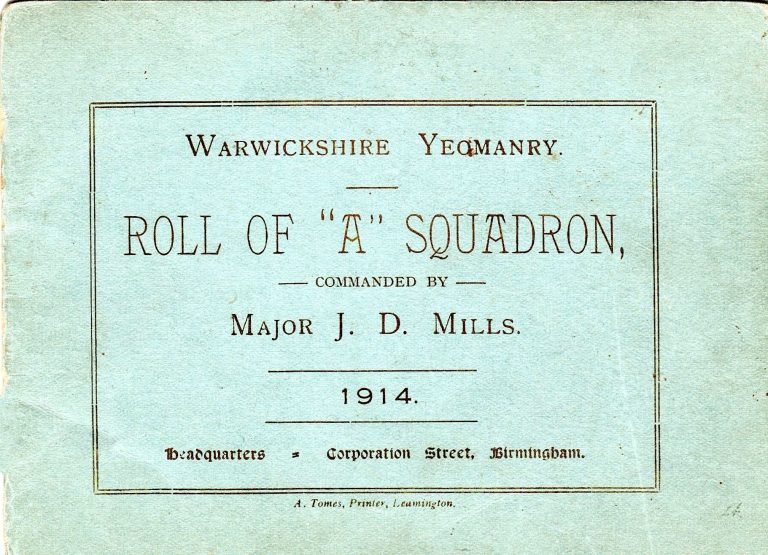
This fifteen-page booklet was published in April 1914. It lists the Regimental Staff on page 2 see enclosure and provides the names of the six Officers in ‘A’ Squadron
together with their home addresses on page 3:
Major J.D. MILLS
Captain Lord GUERNSEY *
Captain R.S. WILSON
Lieutenant L.B. JOYNSON
2nd Lieutenant G.A. LLOYD ***
2nd Lieutenant H.C. COULSON (Commissioned 21.5.1914) ****
The booklet provides the following details for 105 enlisted men serving in ‘A’ Squadron, Warwickshire Yeomanry, Birmingham, compared with 106 men in the 1913 booklet:
Date of enlistment
Regimental Number
Rank
Name and Initials
Home address
and Remarks
The last man to join ‘A’ Squadron prior to this booklet being published was 2088 Pte Z.P. SHEEN who enlisted on 27 February 1914. He served with the Regiment overseas from 24 April 1915 and was discharged on 11 February 1919.
Twenty-two recruits joined ‘A’ Squadron plus three transfers in, to replace twenty-six men who had left during the previous 12 months, which accounts for the net reduction of one man.
Unfortunately, we do not have a complete run of printed Squadron Rolls covering the
period 1900 to 1912 in the Museum Archive. Those Rolls we do have continue to prove most useful when responding to research enquires.
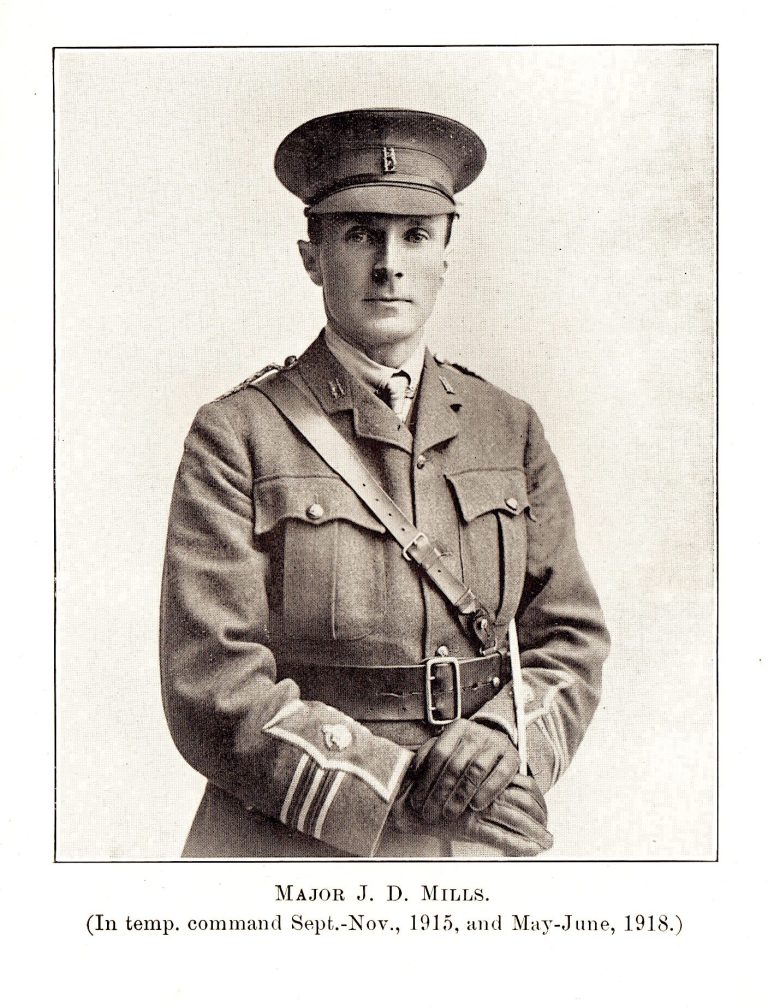
A picture of Major J. D. MILLS who commanded ‘A’ Squadron. Warwickshire Yeomanry is enclosed. This image is from page 178 of ADDERLEY’s ’The Warwickshire Yeomanry in the Great War’ published in May 1922.
Observation :
Captain Lord GUERNSEY *(Lieut. late Irish Guards), Capt. 17 August 1910, re-joined Irish Guards August 1914, KIA France (Battle of Aisne, 14 Sept 1914.
G.A LLOYD *** Lieutenant 11.12.14. Captain 1.6.16. Special Service E.E.F. & Aust. Imp. Force Staff (Sir G.A. LLOYD G.C.I.E., D.S.O. became Lord G.A. LLOYD)
2nd Lieutenant H.C. COULSON ****Joined 1911, Lieutenant 21.5.14. Captain 24.8.16.
13
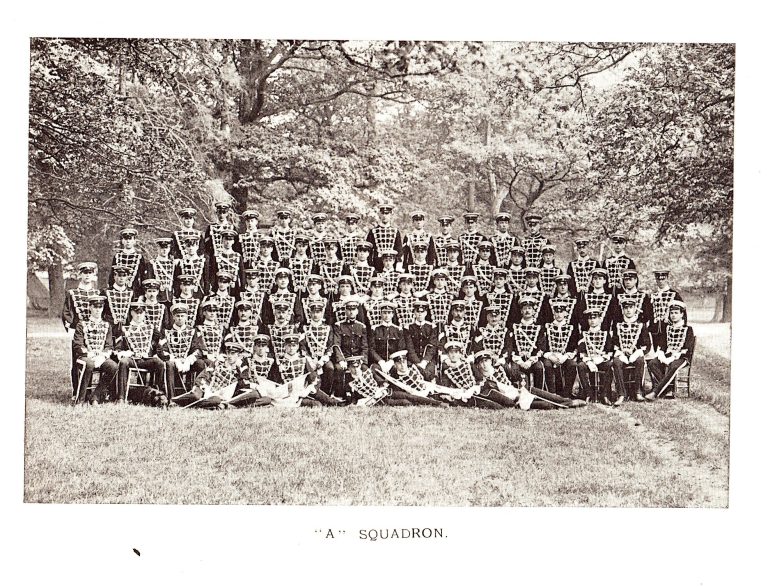
‘Combe Park 1912’ - a photographic record
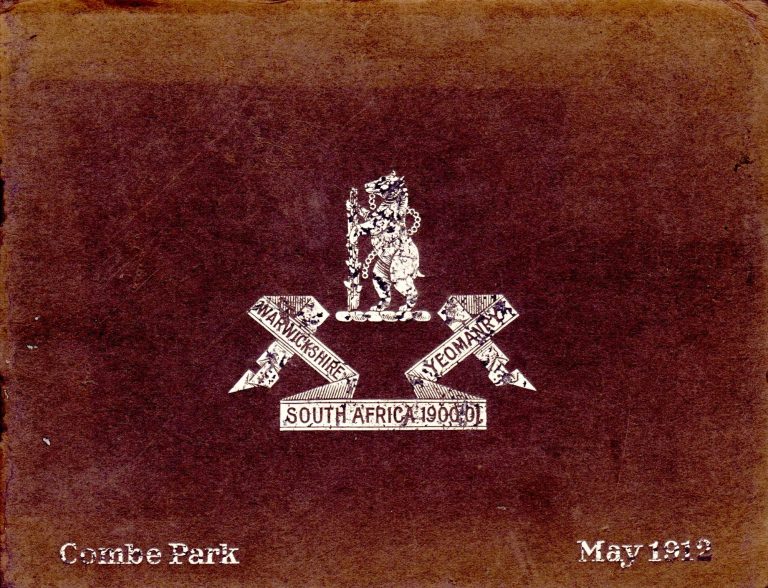
ADDERLEY records that ‘on the 17th May 1912 the Regiment
assembled at Combe Park, by kind permission of the Earl of CRAVEN to undergo the Annual Training, and the muster was within very few of full strength, comprising 21 Officers and 399 N.C.O.s and men.
This booklet published by ELLIOT & FRY, London contains 14 group photographs:
Officers, Sergeants, Corporals, Regimental Staff, Permanent Staff
‘A’ Squadron, ‘B’ Squadron, ‘C’ Squadron, ‘D’ Squadron
Band, Trumpeters, Signallers, Scouts, Maxim Gun
This is a unique photographic record and whilst it’s possible to identify most of the Officers and some of the senior N.C.O.’s from other photos in the Museum, when it comes to identifying individual Yeoman this has proved extremely challenging.
Thankfully some families of those who served in the Regiment in 1912 have assisted in
recent years to identify their ancestor.
Enclosed is a picture of ‘A’ Squadron commanded by Major J.D. MILLS.
There were four Officers in ‘A’ Squadron in 1912: Major J. D. MILLS, Captains Lord GUERNSEY and R.S. WILSON, and Lieut. L.B. JOYNSON.’
There are only three Officers in this photo – two of whom we have so far identified: MILLS and JOYNSON but the challenge is to identify the Officer with his stick resting on his right arm.
Observation - Occasionally copies of this booklet turn up in the second-hand book market on-line.
14
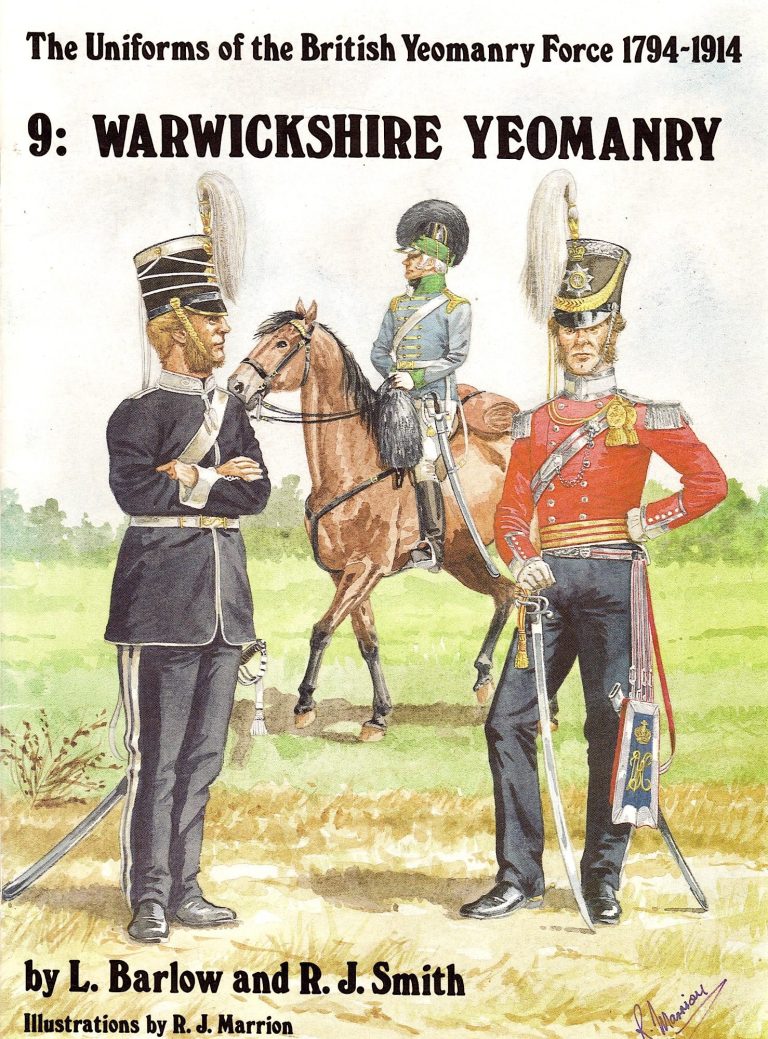
Booklet ‘Combe Park 1912’ and
Booklet No.9: ‘Warwickshire Yeomanry.’
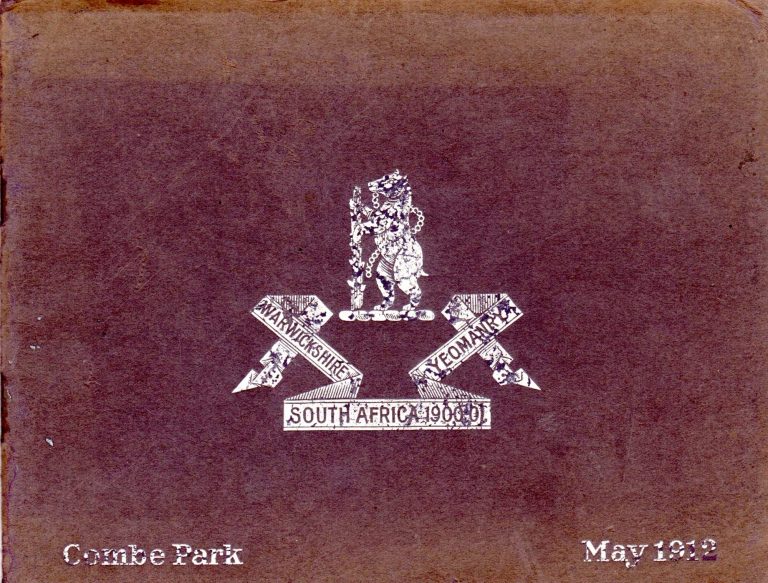
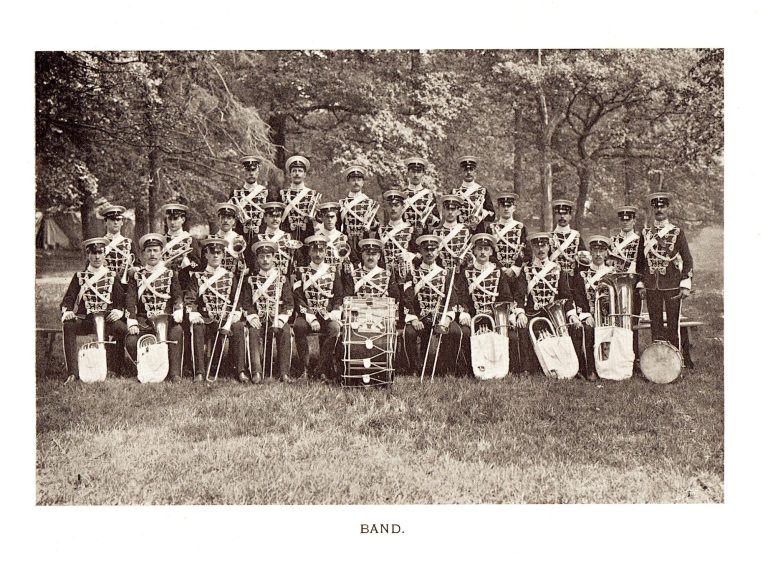
Following on from part 13 the booklet ‘Combe Park 1912’
includes the enclosed image of the Warwickshire Yeomanry Band which was reconstituted under new arrangements in 1912. The Bass Drum in this picture is displayed in the Museum
ADDERLEY records that ‘the services of the Leamington Spa Prize Band was secured with a strength of 25 men,
embodied and qualified to draw pay as Yeoman in camp.
Mr TITCOMBE acted as Bandmaster.’
On the 24th May 1912 the Regimental Band performed in the Public Gardens in Coventry and subsequently played the Regiment back to camp through the main streets of Coventry.
Booklet No.9: ‘Warwickshire Yeomanry in The Uniforms of the British Yeomanry Force 1794-1914’ by BARLOW and SMITH published in 1987 provides a fascinating, illustrated account of the uniforms of the Regiment from 1794 to 1914.
The authors thanked the Warwickshire Yeomanry Museum Trustees for allowing them
access to the collection of early uniforms including copies of various Dress Regulations of the Warwickshire Yeomanry Cavalry during the 19th Century held in the Museum.
Pages 30 and 31 of this booklet include the earliest known reference to there being a Regimental Band, when they played for the 50th Anniversary Dinner at Umberslade on
6 August 1844.[1]
The Regimental Band was present on the Lawn at Warwick Castle for the arrival &
departure of Queen VICTORIA on the 16th June 1858. [2]
The Illustrated London News published a woodcut covering this event which includes a small group of dismounted bandsmen which can be seen in the Museum archive.
Observation
Those of you who are familiar with the Museum will know that the Regiment had a Mounted Band in the 19th Century, for we have two early Kettle Drum Banners on display in the Museum. The whereabouts of the kettle drums and instruments are not known.
[1] See page 71 of ADDERLEY’s ‘History of the Warwickshire Yeomanry Cavalry, published in 1912.
[2] See page 84 of ADDERLEY’s ‘History of the Warwickshire Yeomanry Cavalry, published in 1912.
15
‘The Warwickshire Yeomanry Roll 1913 - Commanded by Colonel F. DUGDALE, C.V.O., T.D.’
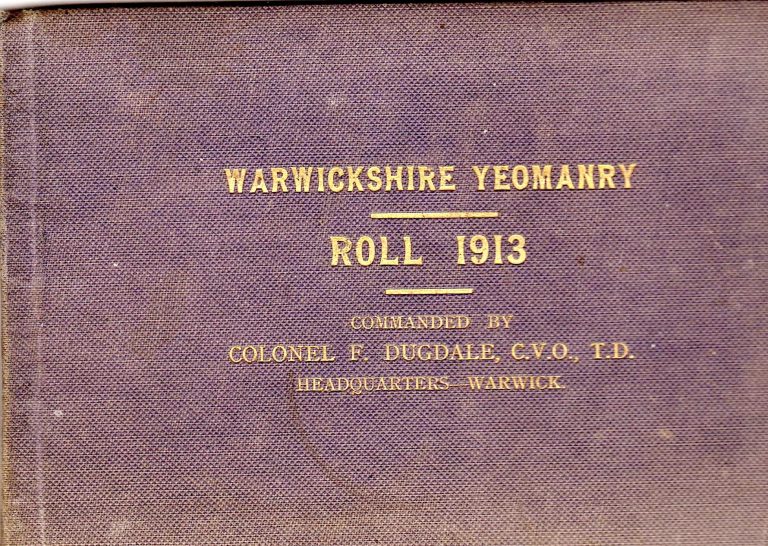
This sixty page booklet was published in April 1913. It lists the Regimental Staff on page 2 see enclosure and provides details of the Officers and Men serving in the Regiment, which I have summarised as follows:
‘A’ Squadron 5 Officers 106 enlisted men
‘B’ Squadron 9 Officers* 122 enlisted men 1 Hon Chaplain
‘C’ Squadron 4 Officers 100 enlisted men
‘D’ Squadron 5 Officers 107 enlisted men
Total 23 Officers 435 enlisted men. Total inc. Hon Chaplain 459.
* Includes Regimental Staff
This booklet provides the following details for the 435 enlisted men in Squadron Order:
Date of enlistment
Regimental Number
Rank
Name and Initials
Home address
and Remarks
Observation.
This booklet along with that for 1914 is a unique record and has proved an extremely
valuable resource when responding to research enquiries.
Those wishing to learn more about individual Officers and Men serving with the Regiment during this period are requested to complete the Museum Enquiry Form see
www.warwickshire-yeomanry-museum.co.uk
This booklet was recovered from Regimental HQ, Priory Road, Warwick prior to its closure in June 1968 and includes ink annotations to construct the booklet for the 1914 Regimental Roll which fortunately has survived the ravages of time.
Regrettably the Museum does not have copies of the printed Regimental Rolls covering the period 1900 to 1912.
16
‘Combe Park 1912’ - a photographic record (2)
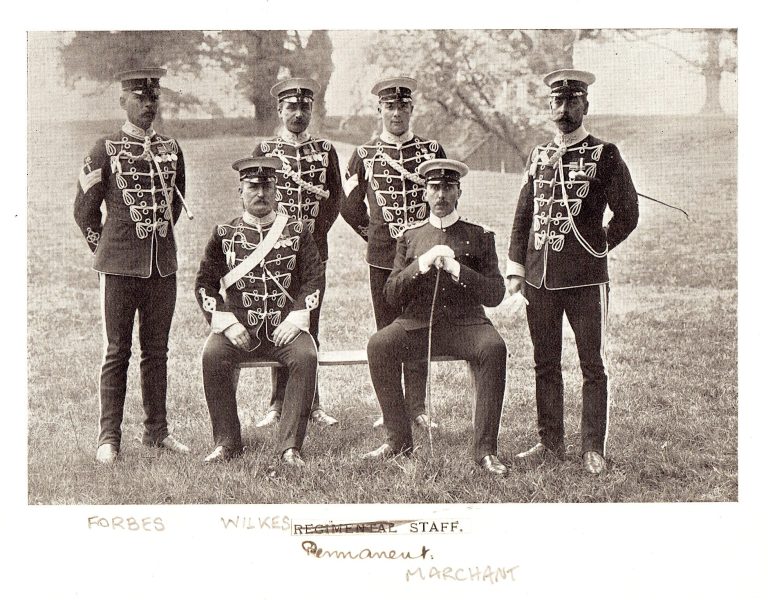
Following on from Parts 13 & 14 ‘Combe Park 1912 – a
photographic record’ of the Warwickshire Yeomanry at their Annual Training Camp published by ELLIOT & FRY.
ADDERLEY records that ‘the camp was pitched on a sandy slope in a convenient position and for the first time Electric Lighting was employed in camp. The messing was still
carried out Regimentally under Lieut. and Quartermaster VALINTINE and proved highly satisfactory
The first week was occupied in Squadron Training, the remainder of the time being
devoted to tactical work. A new system of training was adopted for Recruits who were
separately trained under the Permanent Staff’ - see enclosed picture.
The Permanent Staff are listed on page 213 of ADDERLEY’s ‘History of the Warwickshire Yeomanry Cavalry:’
Adjutant, Captain T.H.S. MARCHANT (13th Hussars) (seated)
Reg. Sergt-Major W. WILKES (8th Hussars) (seated)
S.S.M. CURTIS, ‘A’ Squadron (5th Lancers)
S.S.M. H. FORBES, ‘B’ Squadron (5th Lancers) (standing to the right of WILKES)
S.S.M. G. SENIOR, ‘C’ Squadron (16th Lancers)
S.S.M. R. TREDGER, ‘D’ Squadron (5th Lancers)
Observation
I have only been able to identify three of the six men in this photo - the image is from my copy of the 1912 Booklet which I purchased many years ago.
Occasionally copies of this booklet turn up in the second-hand book market on-line.
17
‘Combe Park 1912’ - a photographic record (3)
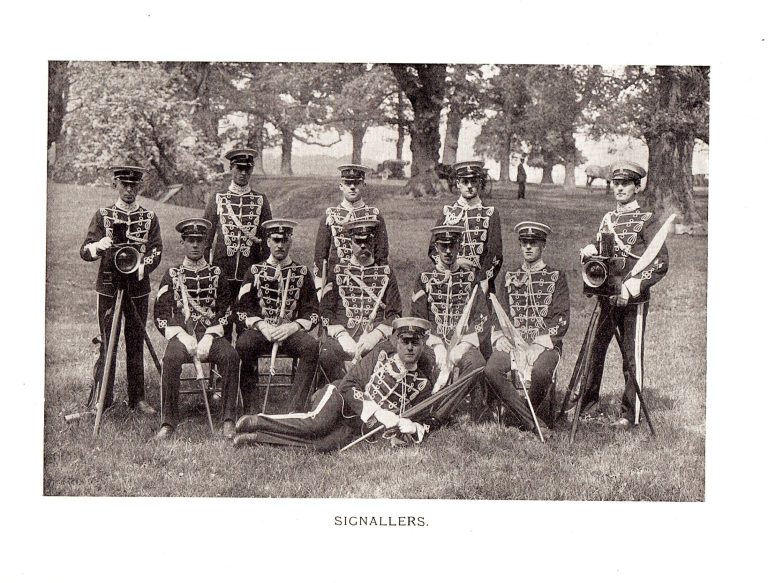
Following on from part 16 ‘Combe Park 1912 –
a photographic record’ of the Warwickshire Yeomanry at their Annual Training Camp published by ELLIOT & FRY.
The booklet contains 14 group photographs and whilst there are helpful captions these do not include names of individuals.
The enclosed picture shows eleven Signallers with their
signal flags and signalling equipment, some faces are
recognizable, and others are not.
The enclosed picture shows eleven Signallers with their signal flags and signalling
equipment, some faces are recognizable, and others are not.
1364 L/Cpl A. READ (‘A’ Squadron)
1492 Sgt-Sig G. TYRRELL (‘A’ Squadron)
ADDERLEY records that ‘Flag Signalling had been practised since 1884 and in 1886
signalling at night had been practised with the flashing lamp from the Tower of St Mary’s Church, Warwick to the Castle Towers with great success.’
In 1911 those serving as Regimental Signallers in the Regiment were classified as 1st Class Signallers except two.
In 1913 the Regimental Signals Officer was Lieut. L.B. JOYNSON – he is not in this photograph.
The 1913 Regimental Roll lists the following Signallers:
1500 Sig-Sgt R. TOZER (‘A’ Squadron) he is standing to the left with signalling lamp,
holding signal flag in this picture.
1266 Cpl R. GADSDEN (‘A’ Squadron)
1623 Pte G.W. BARTLE (‘A’ Squadron)
1703 Pte H.N. BURROWS (‘A’ Squadron)
1858 Pte P. BUSHBY (‘A’ Squadron)
1859 Pte M. LANGDON (‘A’ Squadron) * promoted to Cpl by 1914.
1719 Pte H.F. TWINE (‘A’ Squadron)
1535 Pte W.J. BUTLIN (‘C’ Squadron)
Enclosed is an extract from ‘’he Warwickshire Yeomanry Pocket Book 1914’ re Semaphore.
Observation
I am not sure who the Squadron Sgt-Major sitting in the middle of the front row is.
* The answer may be in Cpl M. LANGDON’s pre-WW1 photograph album. LANGDON served with the Signal Troop during WW1 – his two photograph albums provide a unique record with supporting captions.
18
‘Combe Park 1912' – a photographic record’ (4)
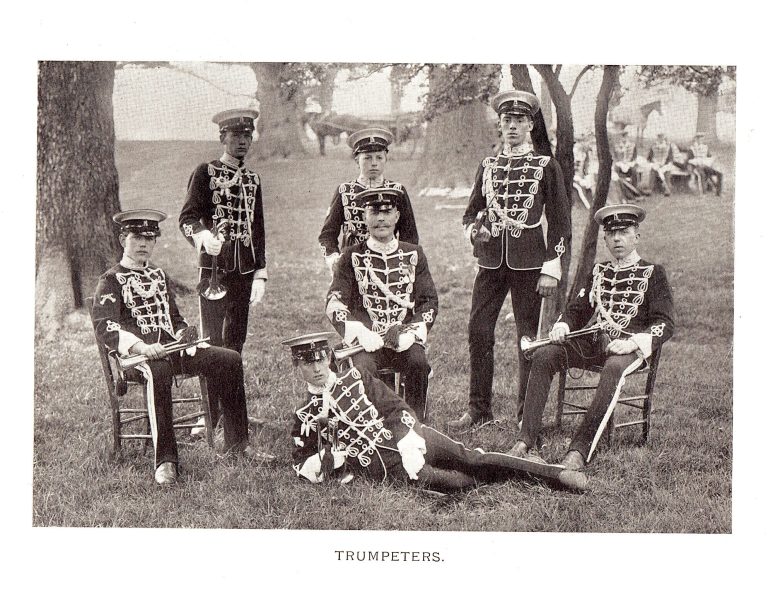
Following on from part 17 ‘Combe Park 1912 –
a photographic record’ of the Warwickshire Yeomanry at their Annual Training Camp published by ELLIOT & FRY.
The booklet contains 14 group photographs and whilst there are helpful captions these do not include names of individuals.
The enclosed picture taken in May 1912 shows seven Warwickshire Yeoman all but one of them is wearing the distinctive arm badge for a Trumpeter.
The Squadron Rolls which have survived for 1912 & 1913 provide clues as to who these
seven men are:
1800 Trptr. T.J. SHILVOCK, ‘A’ Squadron (Recruit enlisted 1.12.11)
704 Sgt/Trptr. C.W. ROBBINS, ‘B’ Squadron (enlisted 13.5.01) *
1688 Trptr. M.D. ROBBINS, ‘C’ Squadron (enlisted 29.10.10)
1724 Trptr. F. STRUTT, ‘B’ Squadron (enlisted 4.3.11) ‘C’ Squadron in 1913
1791 Trptr. W.C. WIGLEY, ‘C’ Squadron (enlisted 25.11.11)
1276 Lc-Trptr D.H. GARDINER, ‘D’ Squadron (enlisted 19.4.06)
1865 Trptr. H.C. DAVIS, ‘D’ Squadron (Recruit enlisted 4.3.12)
Observation
* 704 Sgt/Trptr C.W. ROBBINS is seated in the middle of this group.
None of the above Trumpeters serving with the Regiment in 1912 or thereafter have been the subject of research enquiries during the past six years, nor have we received any digital images of these seven men which might help to confirm their identity.
6
Title
Lorem ipsum dolor sit amet, consectetuer adipiscing elit. Aenean commodo ligula eget dolor. Aenean massa. Cum sociis natoque penatibus et magnis dis parturient montes, nascetur ridiculus mus.

7
Title
Lorem ipsum dolor sit amet, consectetuer adipiscing elit. Aenean commodo ligula eget dolor. Aenean massa. Cum sociis natoque penatibus et magnis dis parturient montes, nascetur ridiculus mus.
8
Title
Lorem ipsum dolor sit amet, consectetuer adipiscing elit. Aenean commodo ligula eget dolor. Aenean massa. Cum sociis natoque penatibus et magnis dis parturient montes, nascetur ridiculus mus.
9
Title
Lorem ipsum dolor sit amet, consectetuer adipiscing elit. Aenean commodo ligula eget dolor. Aenean massa. Cum sociis natoque penatibus et magnis dis parturient montes, nascetur ridiculus mus.
10
Title
Lorem ipsum dolor sit amet, consectetuer adipiscing elit. Aenean commodo ligula eget dolor. Aenean massa. Cum sociis natoque penatibus et magnis dis parturient montes, nascetur ridiculus mus.