19
‘Combe Park 1912' – a photographic record (5)
Following on from part 18 ‘Combe Park 1912'
a photographic record of the Warwickshire Yeomanry at their Annual Training Camp published by ELLIOT & FRY.
The booklet contains 14 group photographs and whilst there are helpful captions these do not include names of individuals.
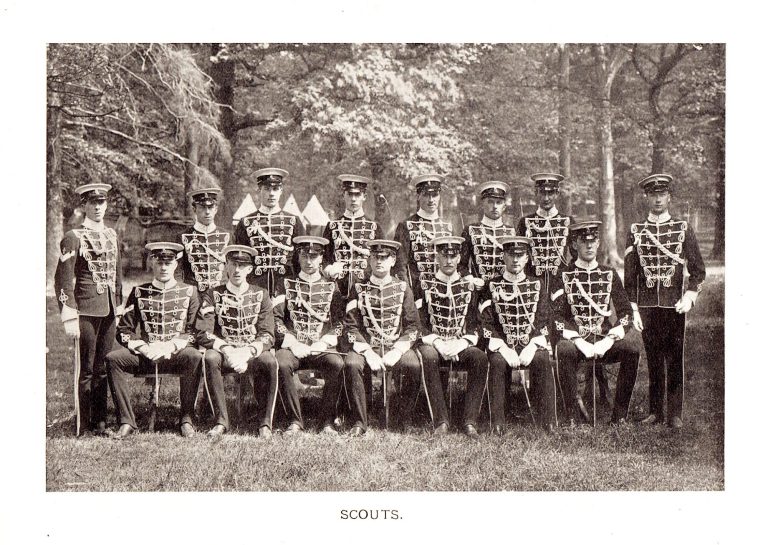
The enclosed picture shows fifteen Warwickshire Yeomanry Scouts, most NCO’s are
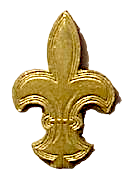
wearing a distinctive badge on their right arm above their chevrons - see image of badge below.
The 1913 Squadron Rolls include:
1 Scout, 14 Regimental Scouts and 9 Squadron Scouts all with enlistment dates prior to May 1912. So by inference the 15 Scouts in this picture taken in May 1912 include the following Regimental Scouts:
1152 L/Sergt. T.T. COOPER, ‘A’ Squadron, ‘A’ Squadron, Scout
1087 L/Sergt. R.V. PAYTON, ‘A’ Squadron, Regt. Scout (enlisted16.12.03)
1043 Corpl. H. WATKINS, ‘A’ Squadron, Regt. Scout, (enlisted 1.5.03)
1606 L/Cpl. W.W. STURLEY, ‘B’ Squadron, Regt. Scout (enlisted 26.3.09)
1596 Corpl. B. JONES, ‘C’ Squadron, Regt. Scout (enlisted 23.3.09) *
1653 Corpl.F. STATHAM, ‘C ’Squadron, Regt. Scout (enlisted 20.1.10)
788 L/Cpl. T. CARDALL, ‘C’ Squadron, Regt. Scout (enlisted 9.1.02)
1548 L/Cpl. H.A.M. HUTBER, ‘C’ Squadron, Regt. Scout (enlisted 30.1.09)
1152 L/Cpl. M. STOKES, ‘C’ Squadron, Regt. Scout (enlisted 9.5.05)
1638 L/Cpl. J.E. CARLEY, ‘C’ Squadron, Regt. Scout (enlisted 20.11.09)
1689 Pte. A. KING, ‘C’ Squadron, Regt. Scout (enlisted 7.12.10)
1032 Sergt. H. J. MORRIS, ‘D’ Squadron, Regt. Scout (enlisted 11.4.03)
1194 L/Cpl. F.T. COX, ‘D’ Squadron, Regt. Scout (enlisted 17.3.05)
1098 L/Cpl. I.B. WHITEHOUSE, ‘D’ Squadron, Regt. Scout (enlisted 24.1.04)
1468 L/Cpl. E.J. COX, ‘D’ Squadron, Regt. Scout (enlisted 30.3.08).
Trying to put faces to names is proving difficult for most of these men have not been the subject of research enquiries during the past six years.
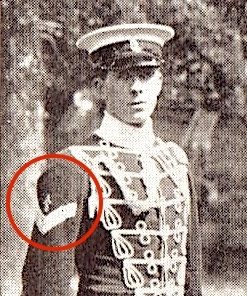
However we do have a picture of a Warwickshire Yeomanry Corporal on horseback (circa 1912) wearing a scout badge on his arm, together with two other pictures of him attending a wedding on 22 November 1916. The reverse of one wedding photo identifies his as Ben and the other as Benj,
Well the chances are that the Corporal on horseback is 1596 Corpl. B. JONES, ‘C’ Squadron Regimental Scout, for he is sitting in the front row of the 1912 group photo – see enlarged image of him.
1596 Corpl JONES may well have served with 2/1st or 3/1st WkY during the Great War, for we have no medal index card for him. This level of detail takes time to produce.
I have not included the names of the 9 Squadron Scouts’ for they are not included in the group photo taken in May 1912.
20
Combe Park 1912 '– a photographic record (6)
Following on from part 19 ‘Combe Park 1912
– a photographic record’ of the Warwickshire Yeomanry at their Annual Training Camp published by ELLIOT & FRY.
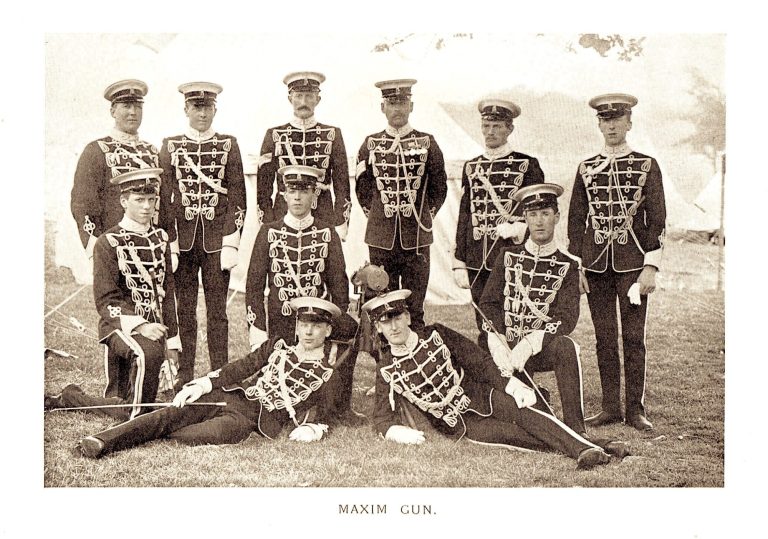
Enclosed is a picture of eleven Yeoman in the Maxim Gun Team in 1912.
ADDERLEY’s ‘History of the Warwickshire Yeomanry Cavalry’ records that ‘the 1904 Annual Camp was held at Ragley Park in May, Colonel Lord HERTFORD in command.
The Inspection was held on1st June by Colonel COURTNEY. A Maxim Gun was supplied to the Regiment for the first time, and on 27th May a Scheme of Reconnaissance was carried out in the neighbourhood of Feckenham in conjunction with the Worcestershire Yeomanry, who were in camp at Westwood Park.’
An examination of the 1912 & 1913 Squadron Rolls provides eleven names of those serving in the Warwickshire Yeomanry Maxim Gun Team, commanded by Captain R.S. WILSON, ‘A’ Squadron, who is not in this picture:
SSM. H.N. FORBES DCM, 5th Lancers (Permanent Staff) ‘B’ Squadron Maxim Gun *
standing wearing his medals
1778 Pte. F. GOULD, ‘B’ Squadron Maxim Gun (enlisted 28.8.1911)
1866 Pte. F. GREEN, ‘B’ Squadron Maxim Gun (enlisted 2.3.1912)
1842 Pte. J. RAVENHALL,’B’ Squadron, Maxim Gun (enlisted 24.2.1912)
1812 Pte. T.H. SANFORD, ‘B’ Squadron, Maxim Gun (enlisted 13.1.1912)
1844 Pte. F.A. VALE, ‘B’ Squadron, Maxim Gun (enlisted 6.2.1912)
778 Sergt. J.W. ARMSTRONG, ‘D’ Squadron, Maxim Gun (enlisted 8.12.1901)
1112 L/Cpl. E. BROWN, ‘D’ Squadron, Maxim Gun (enlisted 19.3.1904)
1488 L/Cpl. C.A. GILBERT, ‘D’ Squadron, Maxim Gun (enlisted 14.8.1908)
1873 Pte. G.H. BULL, ‘D’ Squadron, Maxim Gun (enlisted 28.2.1912)
1629 Pte. W. RITCHINGS, ‘D’ Squadron, Maxim Gun (enlisted 28.9.1909)
Most of these men have not been the subject of research enquiries during the past six years and therefore at this juncture we cannot easily identify them.
Observation
In the winter of 1910, a new departure in training of the Regiment commenced. In place of the old system by which Scouts and Signallers were drawn from all parts of the County it was decided that each Squadron should specialise in one or other of these duties, to make it possible for classes to be held and properly attended by members:
’A’ Squadron Signallers,
‘A’ Squadron - Signallers,
‘B’ Squadron - Pioneers,
‘C’ Squadron - Scouts.
‘D’ Squadron - Machine Gun Detachment.
21
‘The Warwickshire Yeomanry Roll 1914 - Commanded by Colonel F. DUGDALE, C.V.O., T.D.’
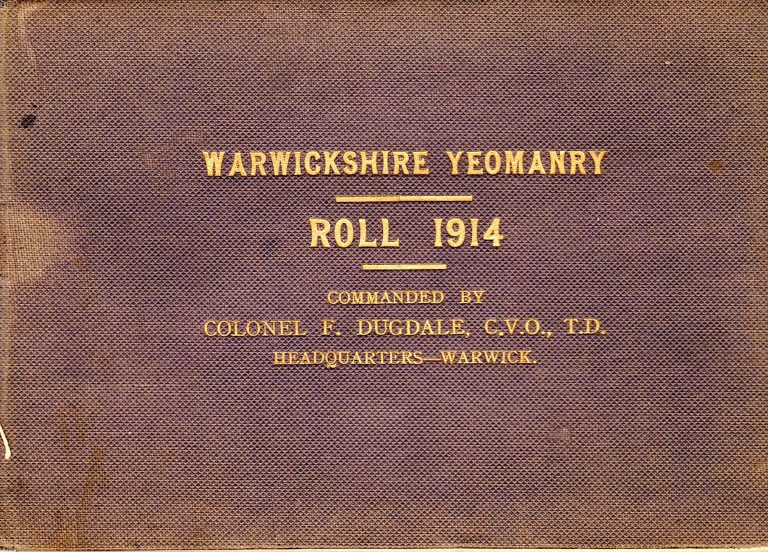
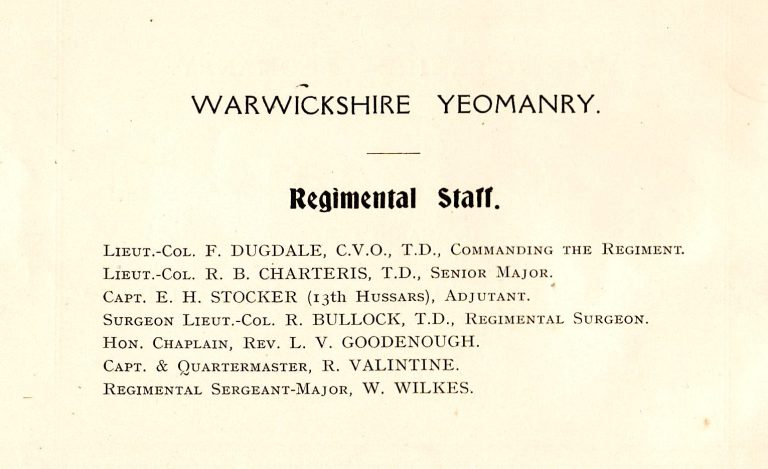
This sixty-five booklet was published in May 1914. It lists the Regimental Staff on page 2 see enclosure and provides details of the Officers and Men serving in the Regiment, which I have summarised as follows:
‘A’ Squadron 6 Officers 105 enlisted men
‘B’ Squadron 10 Officers* 129 enlisted men 1 Hon Chaplain
‘C’ Squadron 5 Officers 117 enlisted men
‘D’ Squadron 5 Officers 105 enlisted men
Total 26 Officers 456 enlisted men. Total inc. Hon Chaplain 483.
* Includes Regimental Staff
This booklet provides the following details for the 456 enlisted men in Squadron Order:
Date of enlistment
Regimental Number
Rank
Name and Initials
Home address
and Remarks
Observation.
This booklet is an extremely valuable resource when responding to research enquiries for those serving in the Regiment as at the 29th April 1914. The last two numbers allocated on that date are 2108 Shoeing-Smith H.G. WHEELER ‘D’ Squadron and
2109 Pte C.W. OSBORNE ‘B’ Squadron.
Those wishing to learn more about individual Officers and Men serving with the Regiment during this period are requested to complete the Museum Enquiry Form see
www.warwickshire-yeomanry-museum.co.uk
This booklet along with that for 1913 (see post 15) was recovered from Regimental HQ, Priory Road, Warwick prior to its closure in June 1968.
Regrettably, the Museum does not have copies of the printed Regimental Rolls covering the period 1900 to 1912.
22
‘Reserve Warwickshire Yeomanry Roll of ‘B’ Squadron commanded by
Major Lord WILLOUGHBY DE BROKE - 1915’
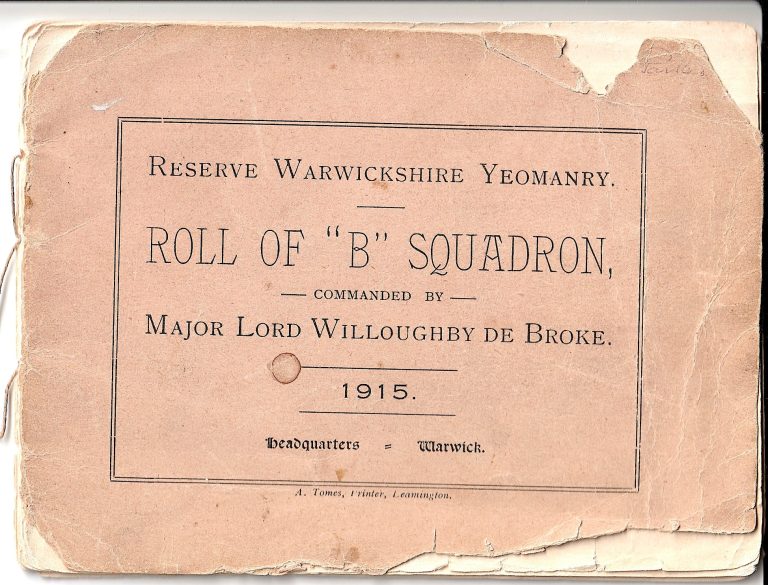
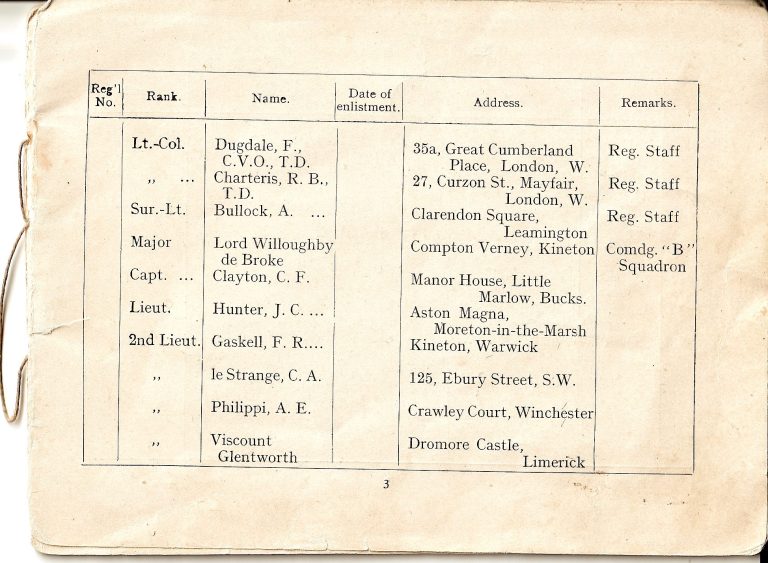
This nineteen-page booklet was published in May 1915. It lists the Regimental Staff on page 2, see enclosure and provides details of the Officers and Men serving in ‘B’ Squadron, which I have summarised as follows:
Regimental Staff Officers 5 RSM 1
Reserve ‘B’ Squadron Officers 7 ORs 152
Total Officers 12 ORs 153
Total 165
It includes home addresses for the Officers.
The following information is provided for the ORs:
Date of enlistment
Regimental Number
Rank
Name and Initials
Home address
and Remarks
Observation.
This ‘lawnmower copy’ is the only Squadron Roll that I have seen for the Reserve Regiment which became the 2/1st Warwickshire Yeomanry.
The War Office issued a letter dated 31st August 1914 authorising the County Associations to form Reserve Units for each Service Unit of the Territorial Force, 60% of which had
volunteered for general service, to be raised and trained at the original Headquarters of the Unit.
The Warwickshire Yeomanry formed three Reserve Squadrons in early September 1914; the men were initially billeted in Warwick: ‘B’ Squadron under Lord WILLOUGHBY DE BROKE; ‘C’ Squadron commanded by Major R.J. BEECH; and ‘D’ Squadron commanded by Major
R. EMMET.
After some weeks the hiring of horses was authorised, and a full complement was
eventually acquired. Mounted training was carried out in earnest, and the three Squadrons exercised in scouting and outpost duty in the country, including field days and night
attacks. Trenches were dug in Warwick Park. For further details see Chapter V11 ‘The Warwickshire Yeomanry in the Great War’ by ADDERLEY.
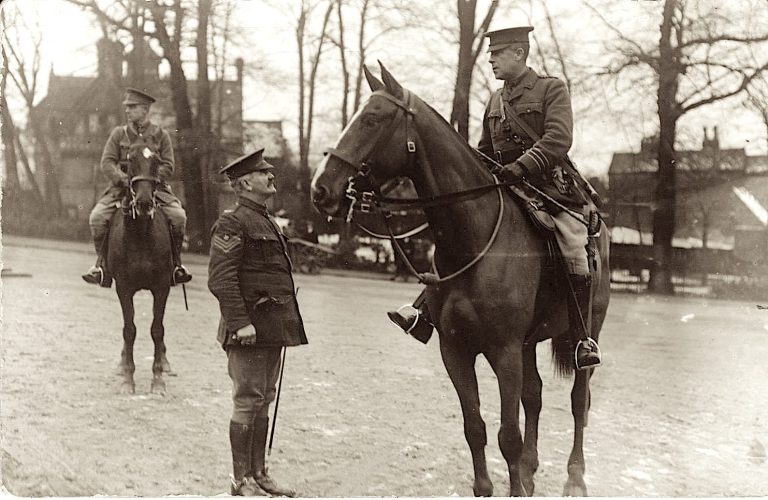
Enclosed is a picture of Major Lord WILLOUGHBY De BROKE on horseback on facing the entrance to Warwick Castle on Castle Hill, Warwick.
If anybody in this group has a copy of the booklet for ‘C’ or ‘D’ Squadron of the Reserve Regiment will they please contact me direct.
Those wishing to learn more about individual Officers and Men serving with the Regiment during this period are requested to complete the Museum Enquiry Form see
www.warwickshire-yeomanry-museum.co.uk
23
‘The Yeomanry Cavalry of Worcestershire
1914-1922’ by C.'
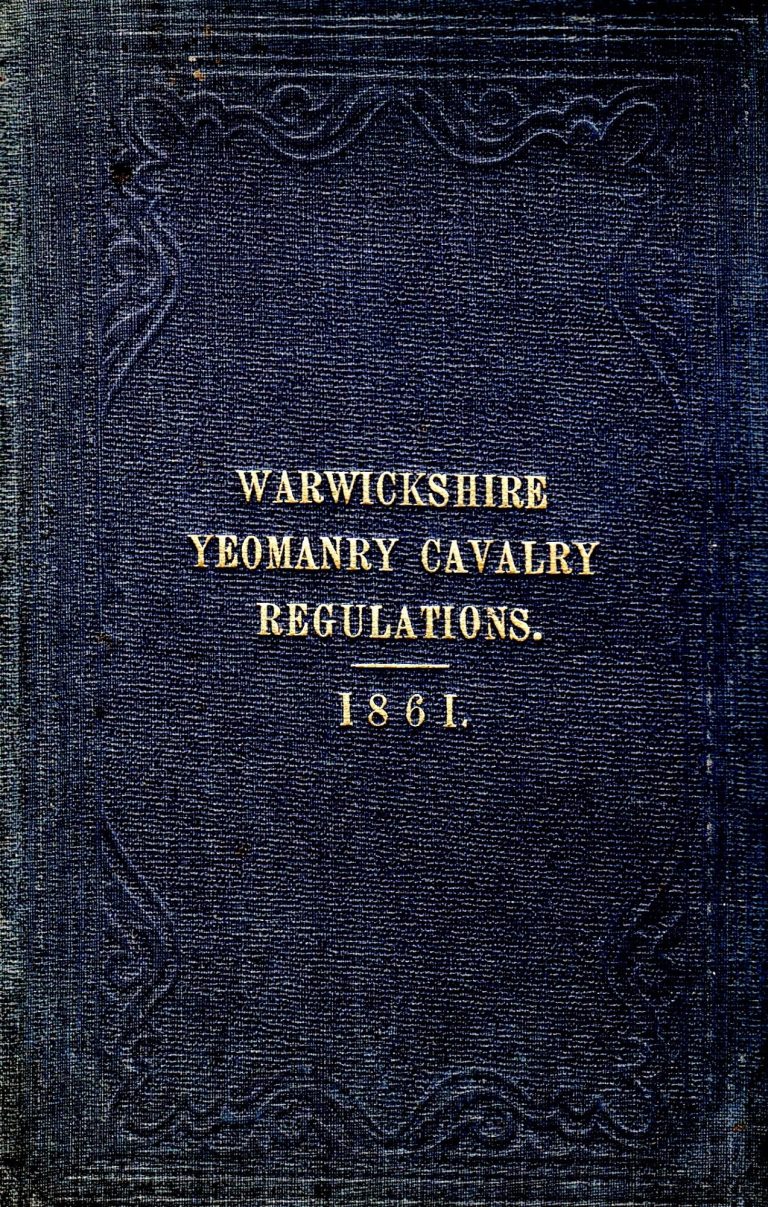
This book was published in 1926 and is dedicated to
‘The Yeoman of Worcestershire Who Laid Down Their Lives 1914-1918.’
As explained in the enclosed preface it is a sequel to ‘The Yeomanry Cavalry of Worcestershire, 1794-1913’ published in 1913. The use of diarised dates throughout the book
enables the reader to evaluate the narrative and see what transpired alongside other printed material for the same date during 1914-18.
The book contains 18 photographs, 14 maps and two appendices.
Appendix A. Record of the 2/1st Worcestershire Yeomanry
Appendix B. Nominal Roll of the 1/1st Worcestershire Yeomanry and the Rolls of
subsequent Drafts.
On Mobilisation in August 1914 the Warwickshire, Worcestershire and Gloucestershire Yeomanry’s formed the 1st South Midland Mounted Brigade and later the 5th Mounted Brigade serving with distinction in the Sinai and Palestine.
In March 1918 the Warwickshire Yeomanry was selected for dismounted service as Machine Gunners in France on the Western Front. They parted company with the Worcesters and Gloucesters at a mounted parade on 1st April 1918. ‘The memories of Suvla Bay, and Romani, Rafa and Gaza, and the bloody brotherhood of Huj, provide an
unbreakable chain’ binding together both the Warwickshire Yeomanry and the Worcestershire Yeomanry.
Observation
I purchased this books for my private collection back in the 1980s from an Antiquarian Book dealer at the Stratford Medal Fair. They have proved to be a good investment for they rarely turn up in the second-hand book market and when they do they command high prices.
24
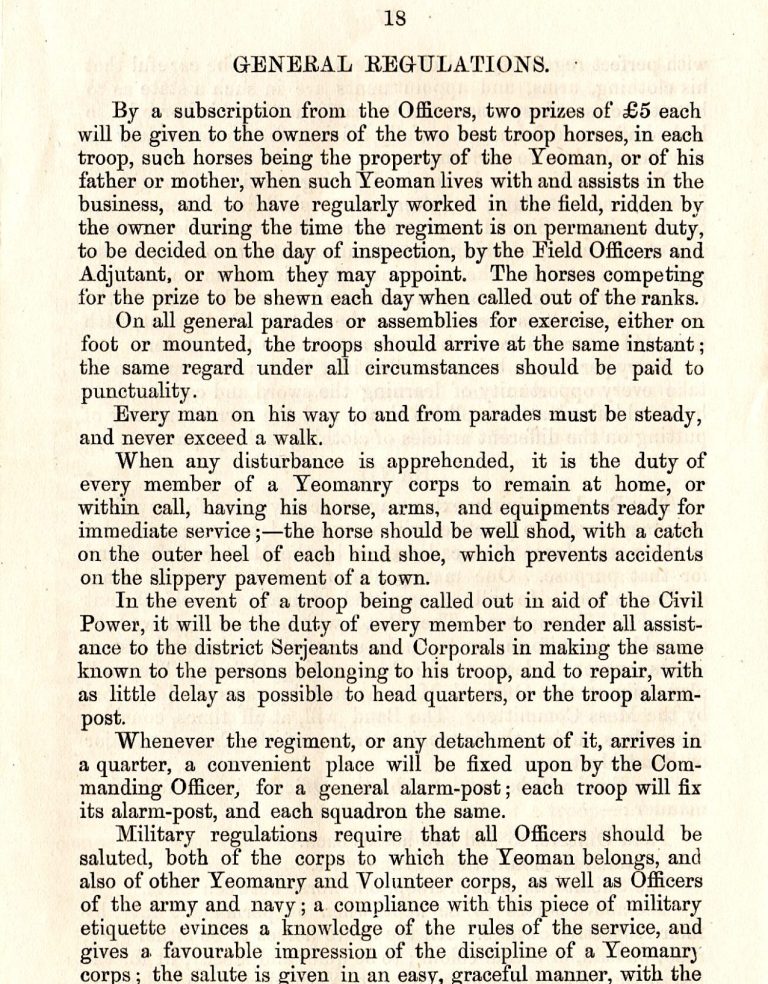
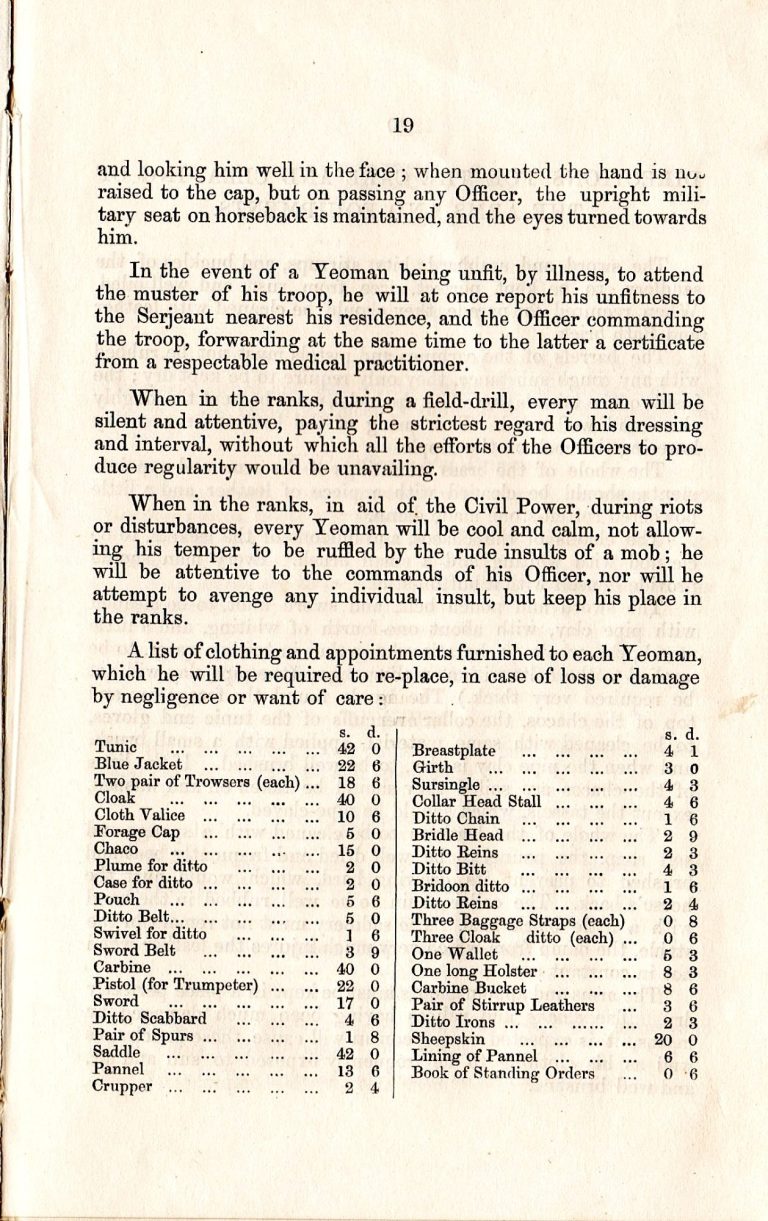
Standing Orders of the Warwickshire
Imperial Yeomanry’
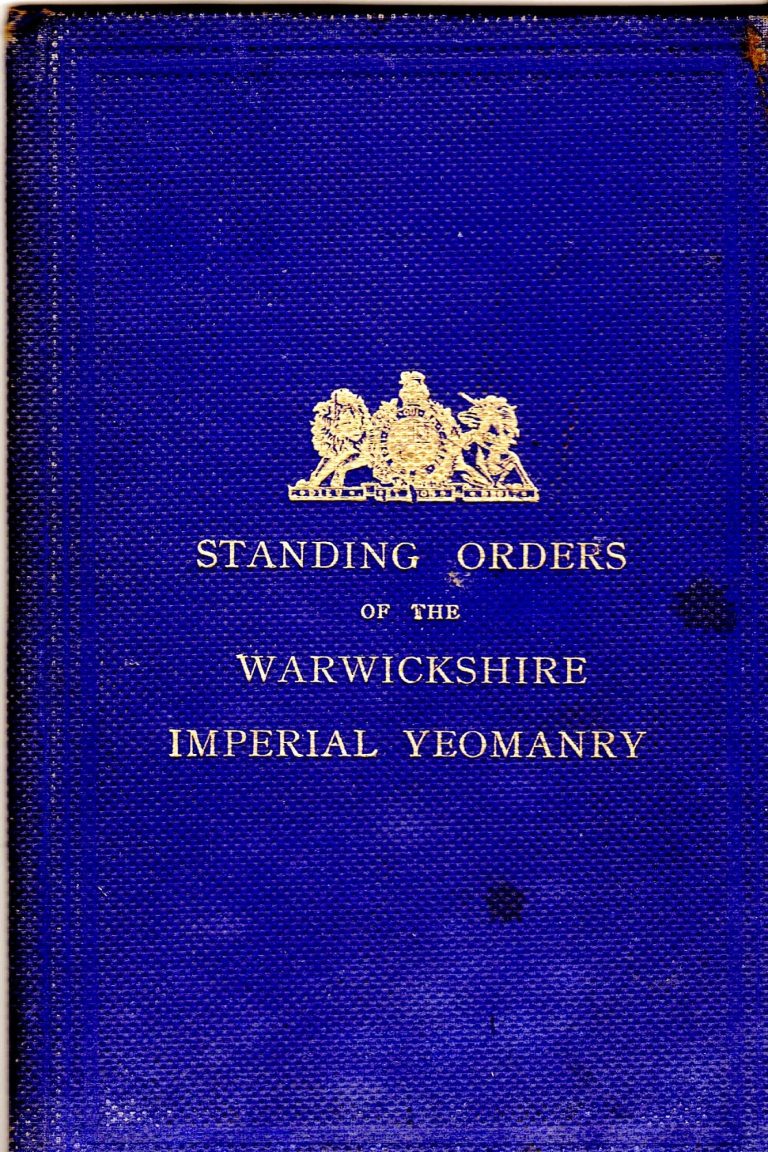
This thirty-two-page booklet was published in 1903.
Pages 4 to 7 cover ‘The Statute Law relating to The Imperial Yeomanry’ in particular The Militia and Yeomanry Acts of 1901 and 1902.
Pages 8 to 16 contain relevant extracts from The Militia and Yeomanry Act:
Part 1. Governance.
Part 11. Voluntary Enlistment .
Part 111. General Provisions such as Service & Oath, Training, Embodiment, Desertion and Fraudulent Enlistment.
17 to 20 cover Rules and Regulation in considerable detail: Duties of Officers, the Officer’s Mess. Troop Fines, Duties of the Quartermaster, Permanent Serjeants, Non-Commissioned Officers, Privates, and the Band.
Pages 21 to 29 cover General Regulations.
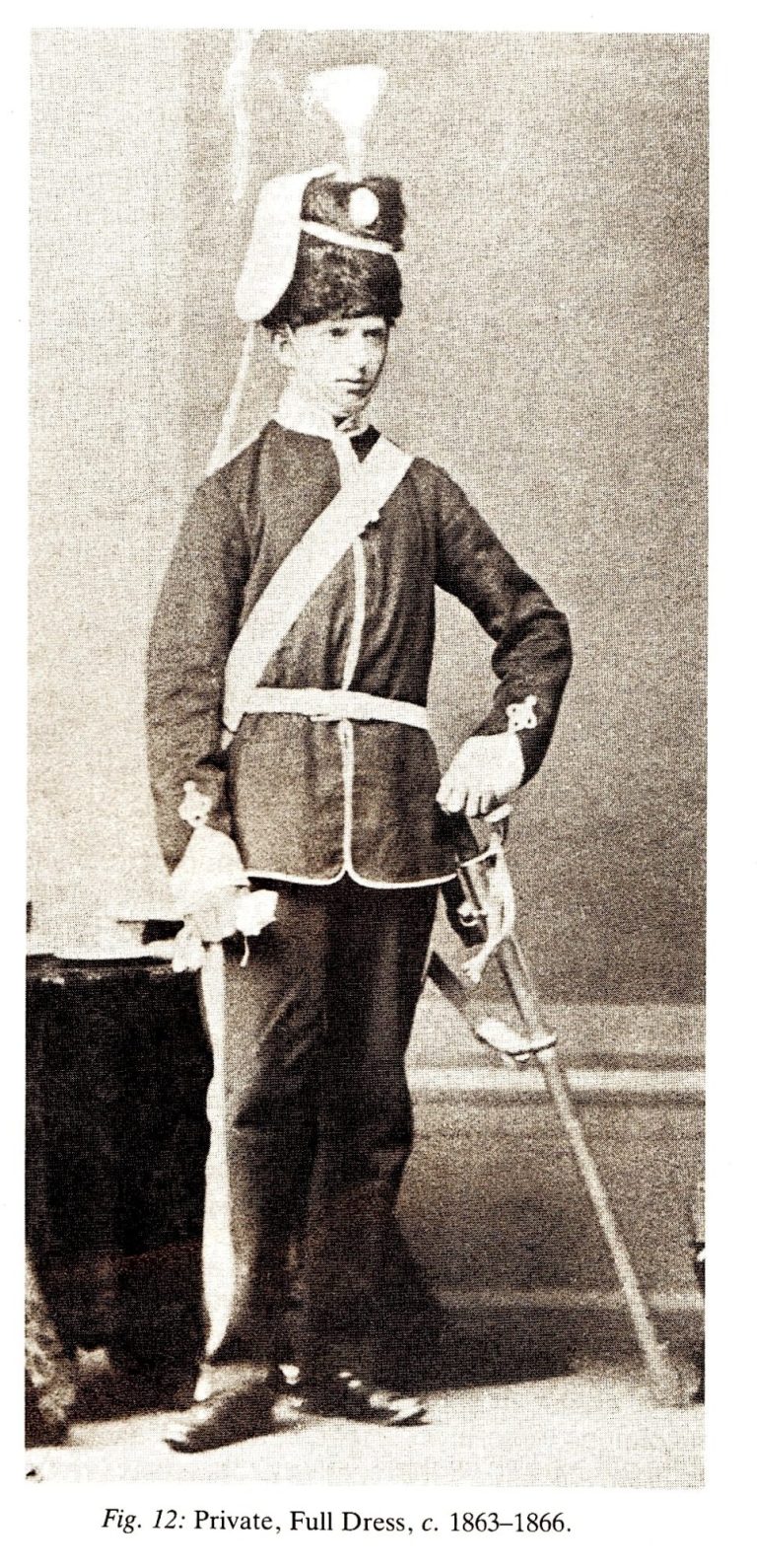
Pages 30 to 32 cover Dress for Officers, N.C.O.’s and Privates – see a photograph of The Warwickshire Imperial Yeomanry at their Annual Camp in Ragley Park in 1905.
Observation.
This booklet was originally owned by Surgeon-Major R. BULLOCK, who was appointed Medical Officer for The Warwickshire Yeomanry Cavalry on 25 April 1895.
BULLOCK was promoted to Hon. Lt.-Colonel Warwickshire Imperial Yeomanry 30 August 1902. The booklet in the Museum includes his signature, dated 1903.
He was appointed Medical Officer for the 2nd Composite Yeomanry Regiment in Western Frontier Sennussi Expedition, August 1915 and was mentioned in despatches March 1916.
Those wishing to learn more about individual Officers and Men serving with the Regiment during this period are requested to complete the Museum Enquiry Form see
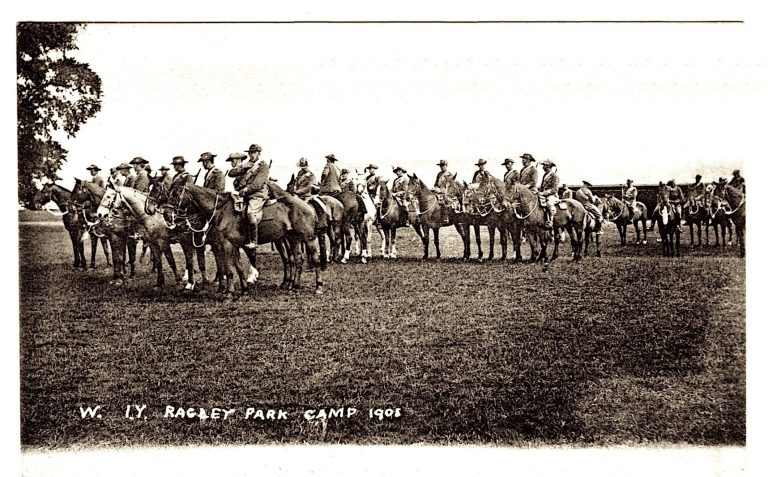
25
‘Regimental Standing Orders of the
Warwickshire Yeomanry 1954’
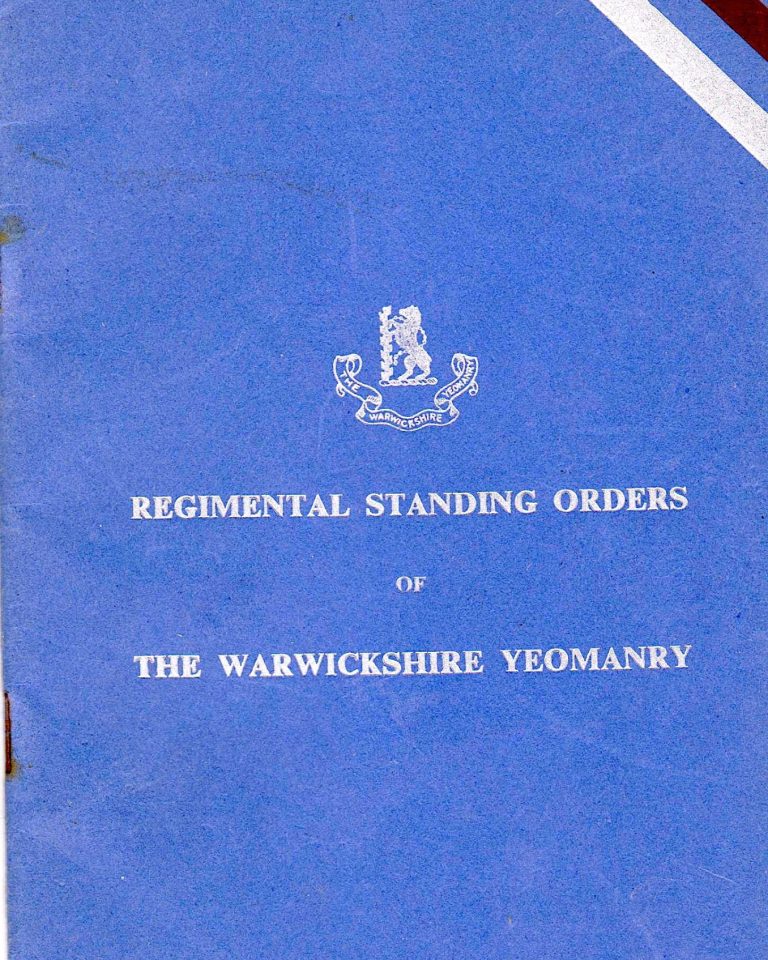
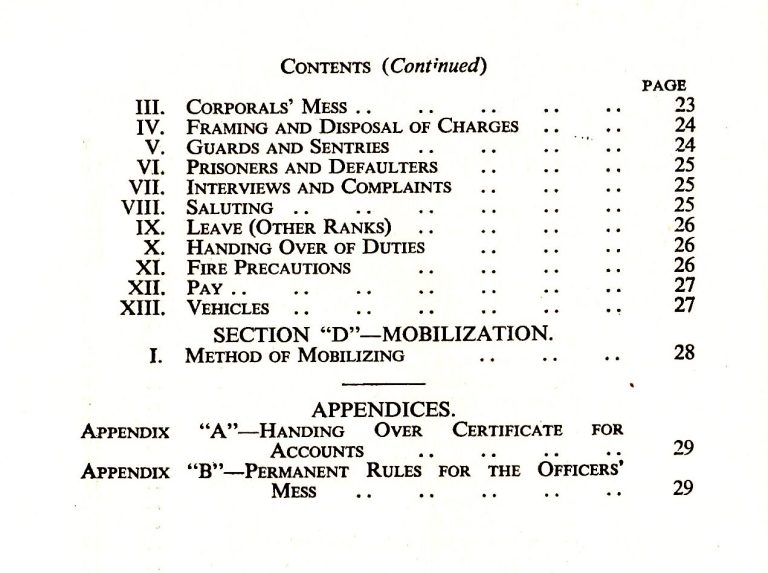
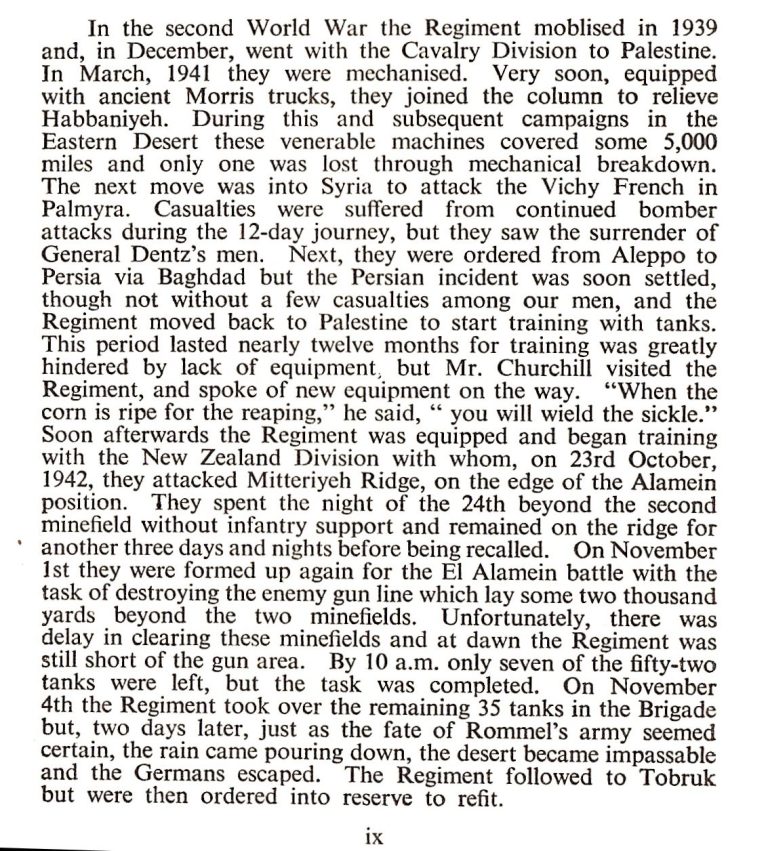
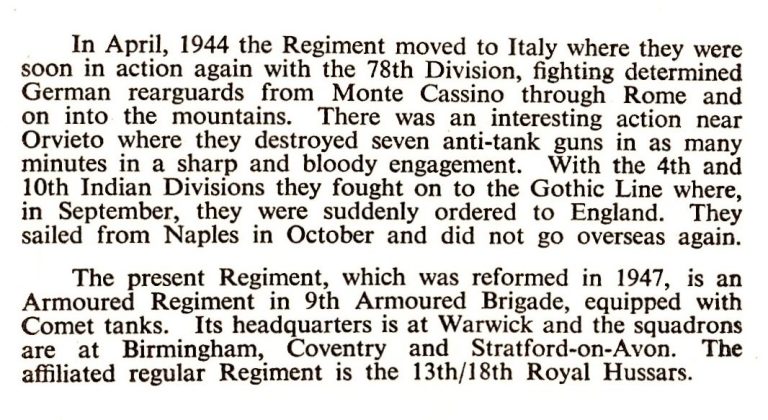
This 41-page booklet includes a useful four-page history of the Regiment, which when first published in 1954 may well have raised a few eyebrows, for the purists amongst us today would spot the glaring errors. Suffice to say my copy here at home now has annotations by way of corrections which will be added to the Museum copy by way of a typed insert. The level of detail in terms of the Standing Orders is quite considerable - see enclosed photos below.
Observation
In 1954 the Warwickshire Yeomanry was commanded by Lieut.-Colonel S.O. EDWARDS MC, TD. The Warwickshire Yeomanry was part of the 9th Independent Armoured Brigade.
In 1954 the Regiment went with the Brigade for the Annual Camp at Tilshead Lodge Camp on Salisbury Plain for what proved to be two of the most ambitious armoured exercises since WW2.
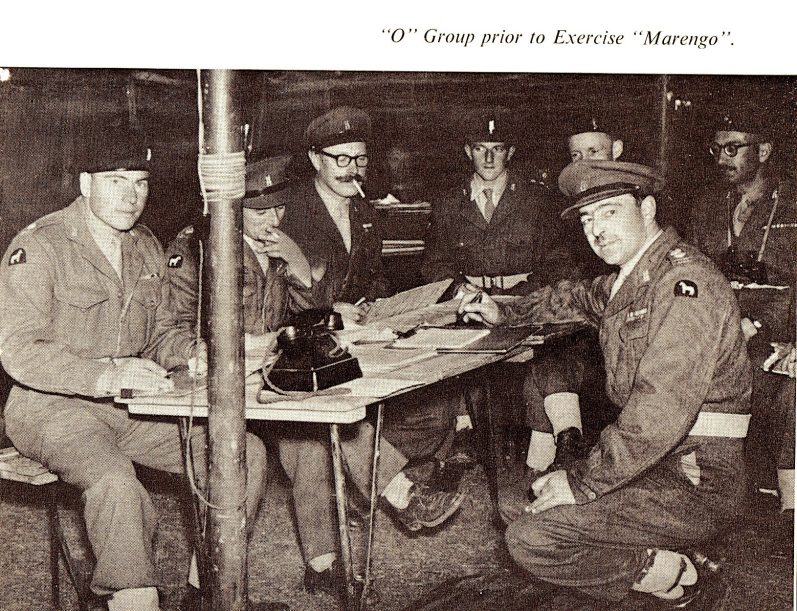
The first week of Camp was spent on preparation and the first two days of the second week was devoted to ‘Exercise Forearm’ which was designed to forewarn the participants of the difficulties they would experience in ‘Exercise Marengo;’ which commenced on the Monday with an approach march in Tanks on the Marlborough Downs. The details of which can be found in ‘Yeoman Yeoman’ on pages 109 to 111 which includes the enclosed picture of the ‘O’ Group for ‘Exercise Marengo’ – Lieut.- Colonel Edwards is leaning in front of the table.
*When studying events, it’s important to go back and examine primary sources rather than just rely on one or more person’s interpretation of history which may not always be entirely accurate.
Those wishing to learn more about individual Officers and Men serving with the Regiment during this period are requested to complete the Museum Enquiry Form see
www.warwickshire-yeomanry-museum.co.uk
26
‘The Charge of The Warwickshire Yeomanry and Q.O. Worcestershire Yeomanry at HUJ 8th November 1917.’
This eleven-page pamphlet was produced by Major E.G. PEMBERTON, O.B.E; M.C., T.D. and was published to
accompany ‘The Plan of the Charge of The Warwickshire and Q.O. Worcestershire Yeomanry at HUJ, 8th November 1917’ which he presented to the Warwickshire Yeomanry Officers on his retirement on 28th October 1927.
This pamphlet is based to a great extent on that in ‘The Cavalry Journal,’ however Major PEMBERTON did not
append his name to this pamphlet. The Plan of the Charge can be seen in the Warwickshire Yeomanry Museum.
Many years ago, I purchased two copies of ‘The Cavalry Journal,’ numbers 100 and 102 which included articles on The Warwickshire Yeomanry, had I not done so then the true identity of the author of this pamphlet might not have revealed itself.
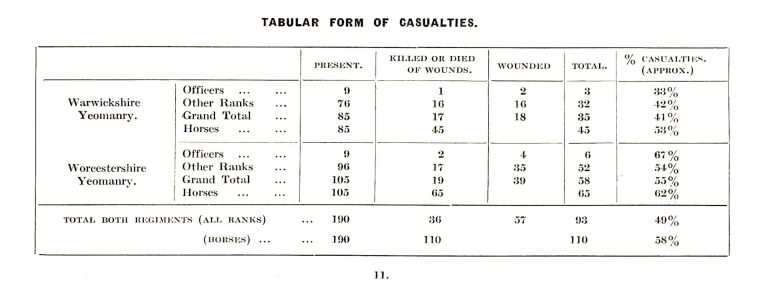
Major Oscar TEICHMEN, D.S.O., M.C., T.D., writing in ‘The Cavalry Journal Vol XXV1, No.102, October 1936 on ‘The Yeomanry at HUJ’ refers on page 503 “to the respective strengths of both Regiments taken from Major E.G. PEMBERTON’s pamphlet which differ from those given in ‘The Official History’ and in the Warwickshire and Worcestershire War Histories. The latter were written soon after the War and were probably copied by the Official Historian.”
See attached Tabular Table from PEMBERTON’s Pamphlet.
Enclosed is a picture of Major E.G. PEMBERTON circa 1924.
Much has been written on ‘The Affair at HUJ’. We have been busy
updating the History Section of the Museum website, which includes this account by way of example https://www.warwickshire-yeomanry-museum.co.uk/huj
Observation
Those wishing to learn more about individual Officers and Men serving with the Regiment during this period are requested to complete the Museum Enquiry Form see
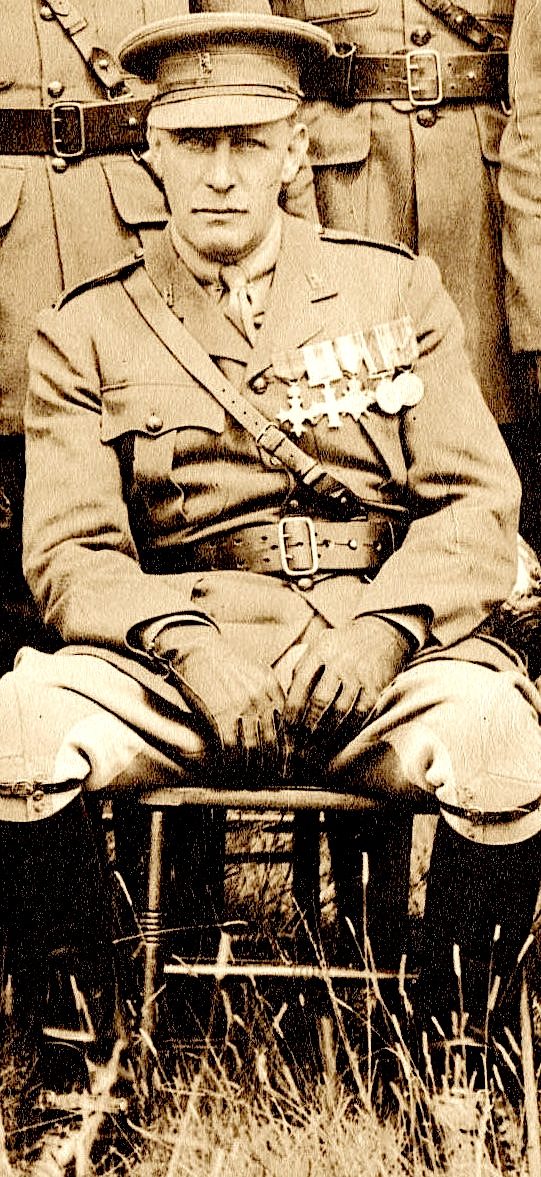
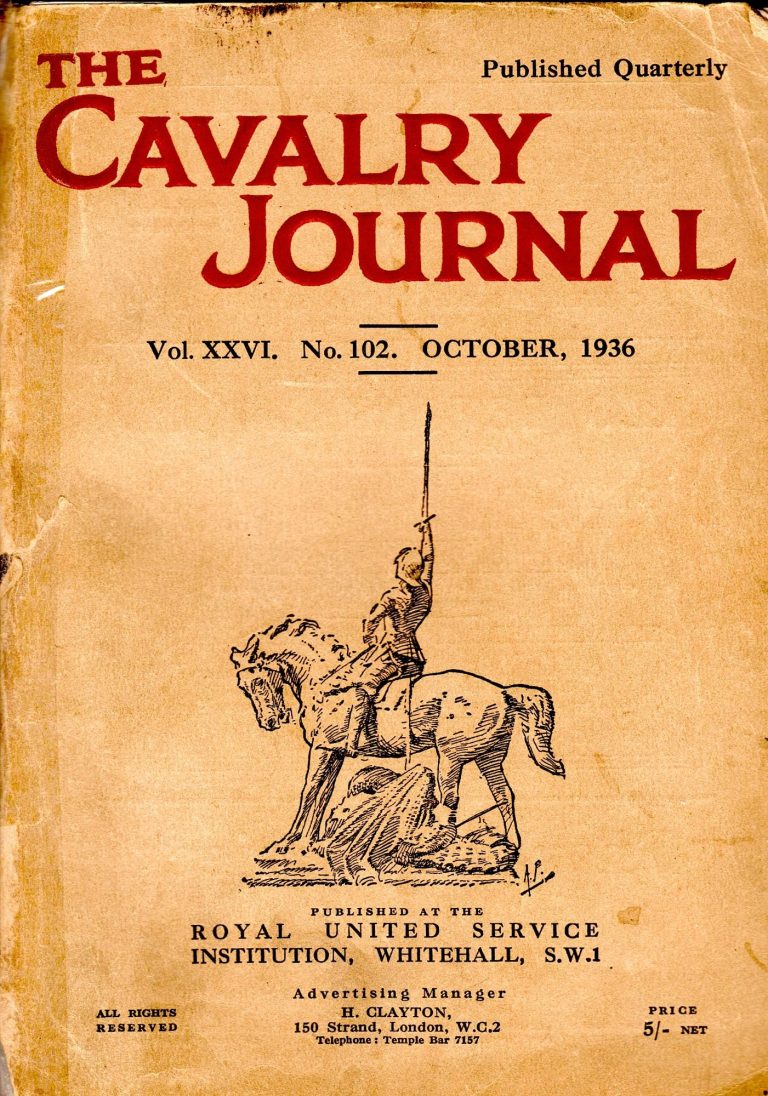
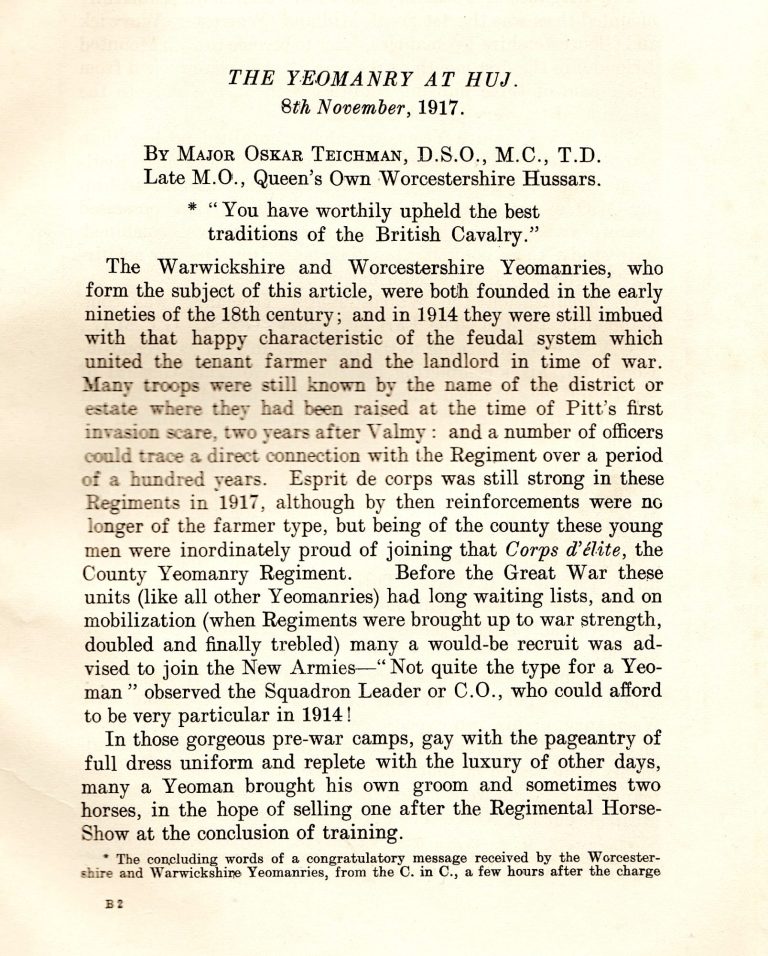
27
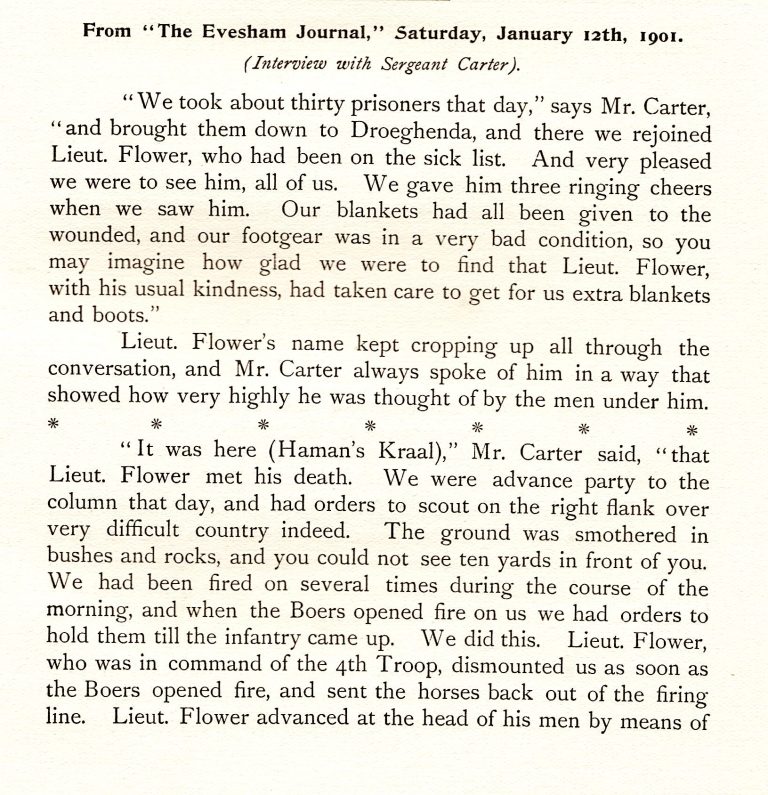
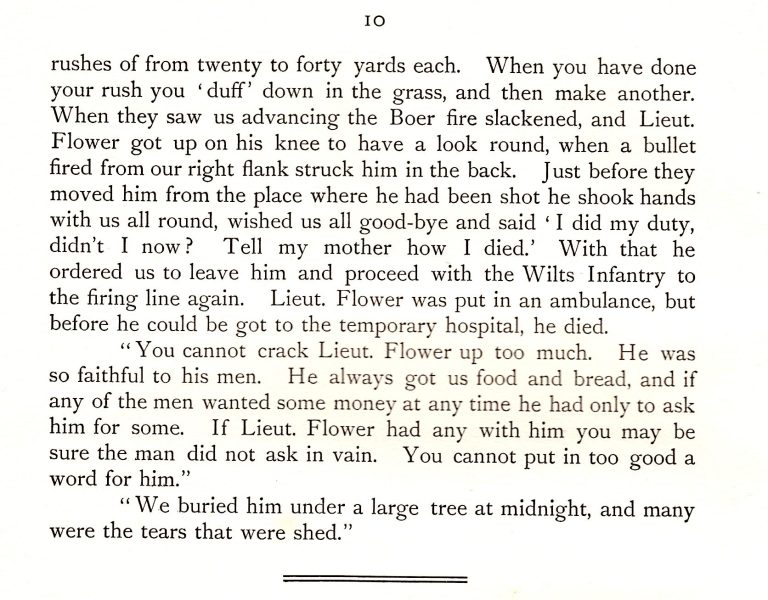
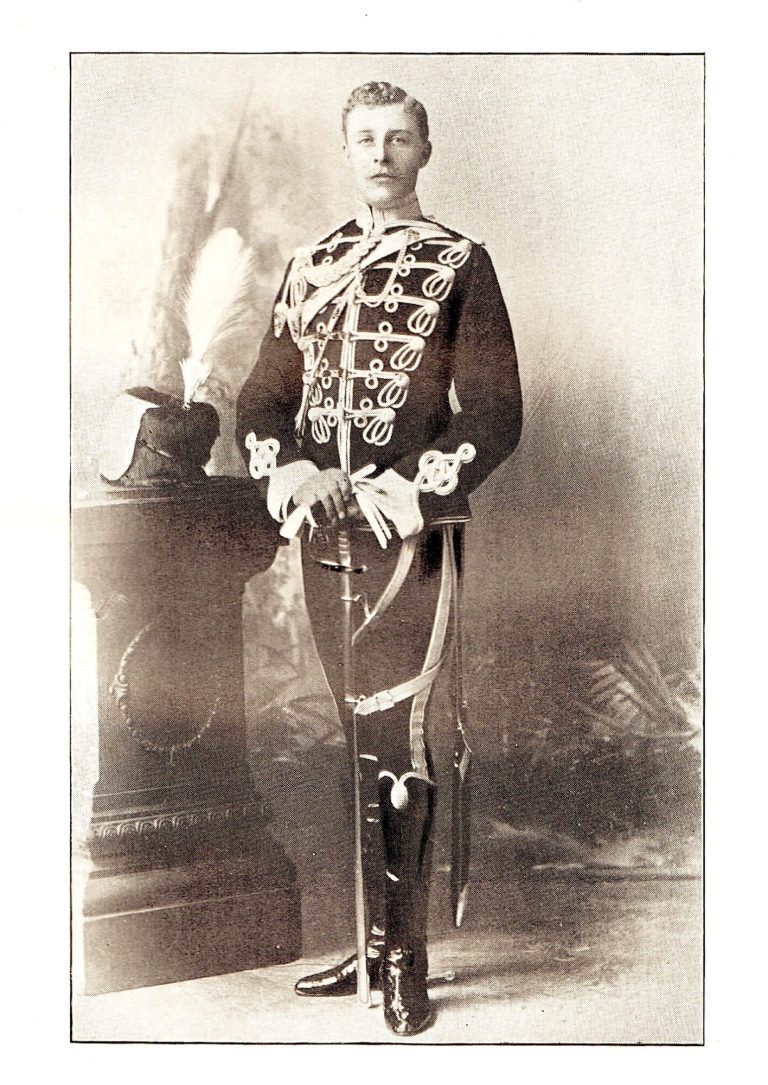
‘Memorial Booklet Richard FORDHAM FLOWER.’
Richard FORDHAM FLOWER was born at Stratford in 1867, and was educated at Eton and Cambridge, after which he came back to live at Stratford, where he joined the local
volunteer Corps, and afterwards the Warwickshire Yeomanry Cavalry. When the War with the South African Republic was declared, and the Yeomanry were asked to
volunteer, he responded to the call. And in January 1900 left Warwick with the 5th Company Warwickshire Imperial Yeomanry for the Cape.
He fell on the 20 August 1900 at Haman’s Kraal, while serving with General PAGET and fighting a rear-guard action with De WET’s forces – see extract from pages 9 and 10.
This forty-three-page illustrated booklet was privately published in 1902 and contains
extracts from ‘The Evesham Journal’, ‘Stratford Herald’ and ‘The Field,’ including those from letters of condolence received by his family.
The booklet provides an account of the unveiling of three memorial windows in his memory which can be found at:
Broadway Parish Church, Shakespeare’s Church, Stratford upon Avon and in St Mary’s Church, Warwick.
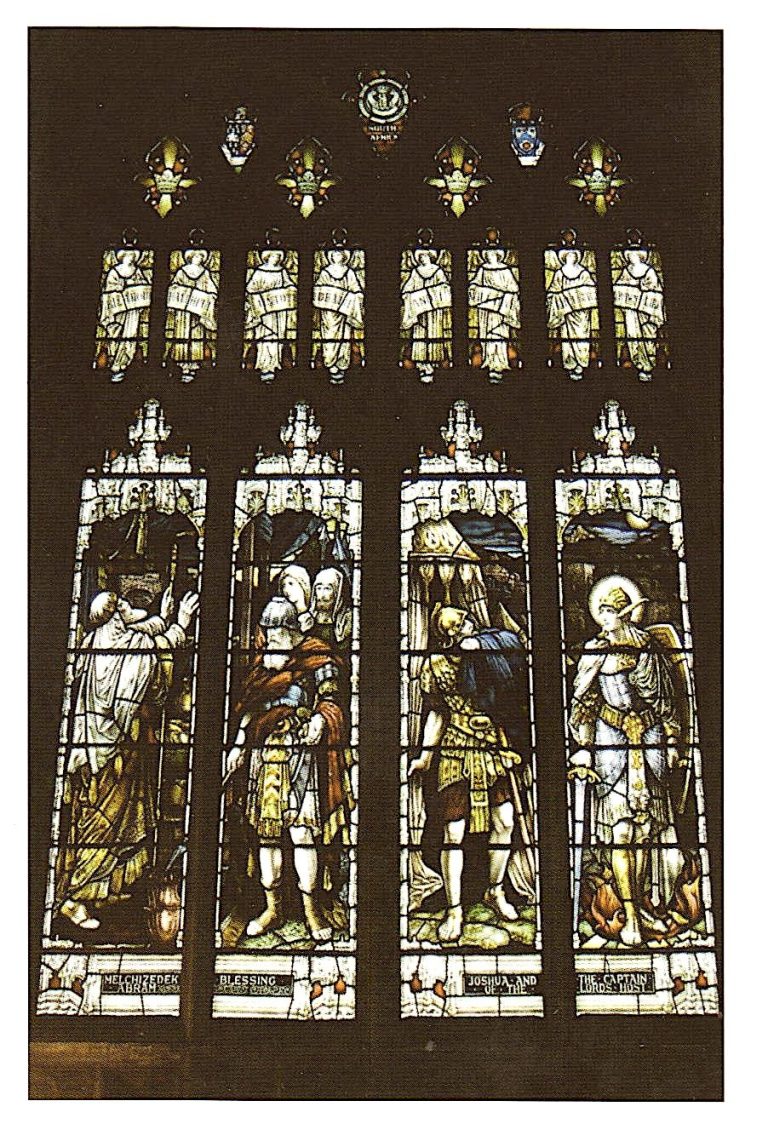
At the Church Parade on 1 June 1902 a memorial window was unveiled in the North Chancel of St Mary’s Church, Warwick which includes the armorial bearings of Major ORR-EWING and Lieut. FORDHAM FLOWER. The window is dedicated to the memory of the Officers and the men who fell during the South African War whilst serving with the Warwickshire Imperial Yeomanry. See image.
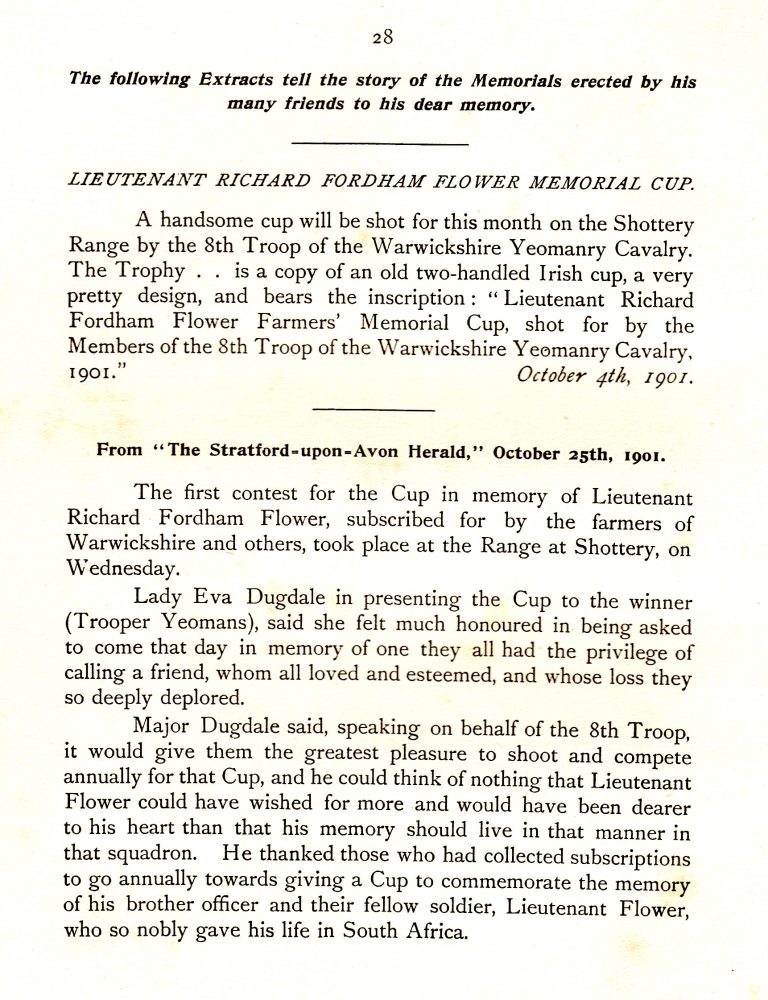
The first contest for ‘The FORDHAM FLOWER Memorial Cup’ took place in October 1901 - see page 28. This cup is on display in the Warwickshire Yeomanry Museum.
Observation
The FORDHAM FLOWER family established Flowers Brewery, Stratford upon on Avon in 1831 - five generations of this family ran this Brewery. The compiler of this booklet did not include his name in this publication which was privately printed by Edward FOX Stratford on Avon possibly in the second half of 1902.
This booklet was signed by ‘Spencer FLOWER, Stratford on Avon’ and donated by the family to the Warwickshire Yeomanry Museum in May 1981.
28
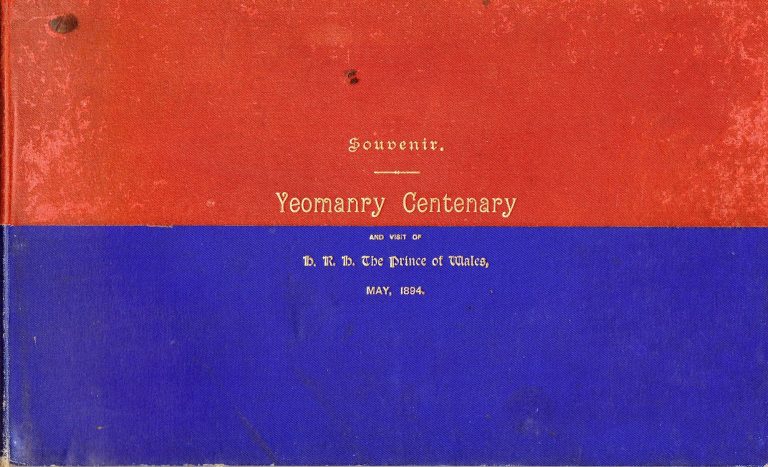
A Souvenir of the
Queen’s Own Royal Staffordshire Yeomanry – Centenary Celebration and Visit of
H.R.H. THE PRINCE OF WALES
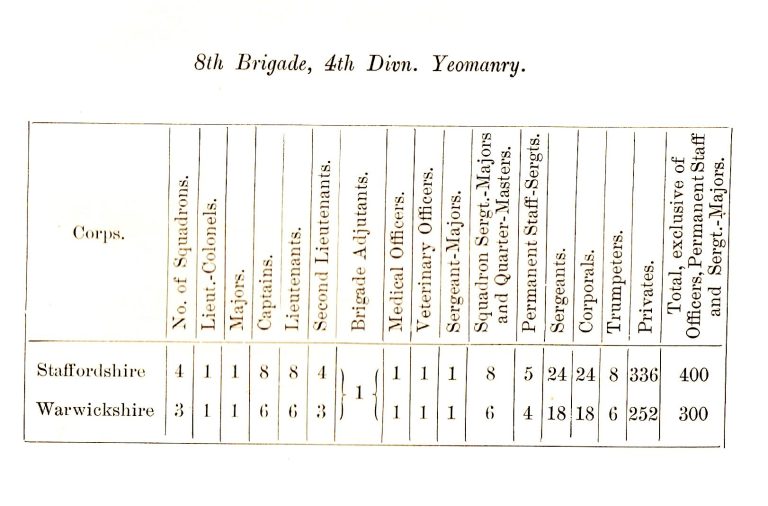
The Warwickshire Yeomanry was ordered to assemble at Litchfield in May 1894, in conjunction with the Queen’s Own Royal Staffordshire Yeomanry, the two Regiments forming together the 8th Brigade, 4th Division of Yeomanry Cavalry.
ADDERLEY’s ‘History of the Warwickshire Yeomanry Cavalry’ published in 1896 pages 129 to 141 provides a good account of the 1894 Yeomanry Centenary at Lichfield. See
composition of the 8th Brigade below.
The Warwickshire Yeomanry Cavalry arrived in Litchfield on 22 May by five special trains, transporting both men and horses and were billeted in the Town. The Headquarters of the Staffordshire Yeomanry was at the ‘George Hotel’ and the Warwickshire Yeomanry H.Q. at the Swan Hotel.
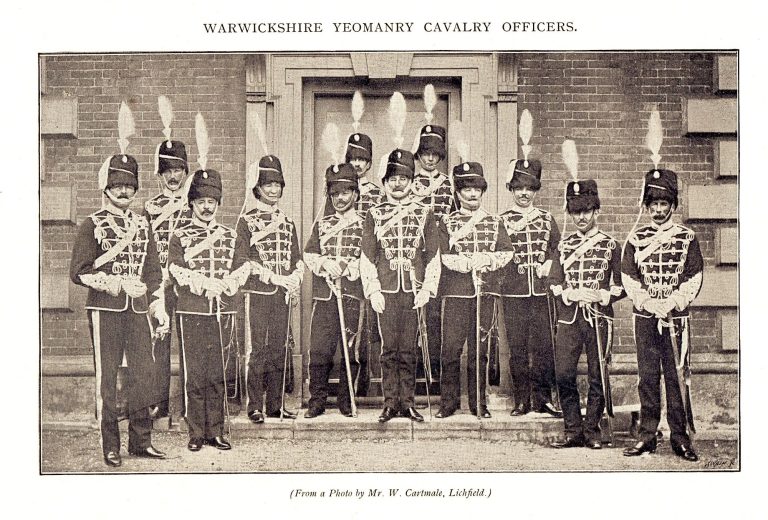
A Souvenir of the Queen’s Own Royal Staffordshire Yeomanry – Centenary Celebration and Visit of H.R.H. THE PRINCE OF WALES records the proceedings in some considerable detail, together with photographs, as published in the Litchfield Mercury of the 2 June 1894 including ‘The Marching-In-State.’
Unfortunately, the group photographs in this souvenir booklet do not include captions to easily identify individual Officers present, other than the Staffordshire Yeomanry who list them alongside the photo of their Officers at Yeomanry House.
ADDERLEY records ‘Tuesday, the 29th was a trying day for men and horses. The usual mounted drill on the Heath was performed in the morning, and later in the day the two Regiments paraded in full dress, for the Reception of His Royal Highness The escort was provided by the Staffordshire Yeomanry and the remainder of the Brigade were detailed
to line the streets from the Trent Valley Station to the Town.
The following day the Brigade was inspected on Whittington Heath by the PRINCE OF WALES. The Birmingham Gazette’s account of the proceedings can be found on pages
135-138 of ADDERLEY’s ‘History of the Warwickshire Yeomanry Cavalry.’
The Celebration of the Centenary of the Warwickshire Yeomanry Cavalry took place in 1895, as the Hundredth Anniversary had been spent away from home.
Those wishing to learn more about individual Officers and Men serving with the Regiment during this period are requested to complete the Museum Enquiry Form see
29
‘The Warwickshire Yeomanry
and Gallipoli’
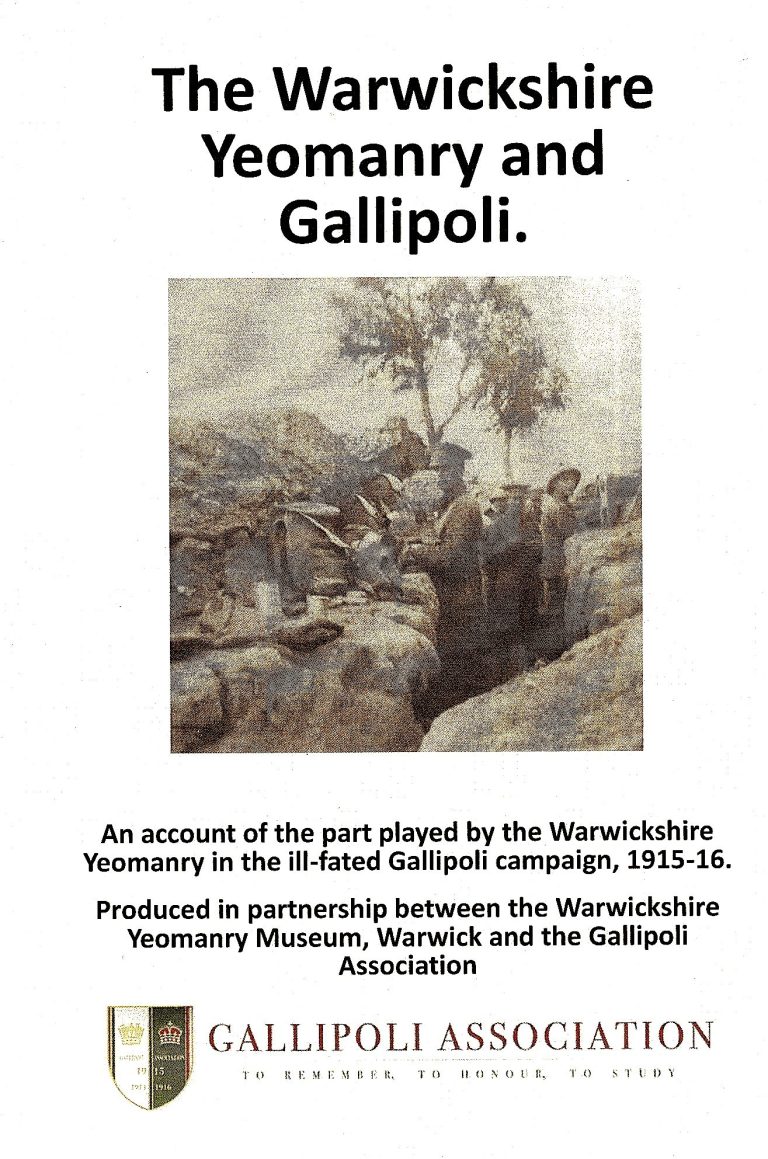
This 12-page illustrated booklet on The Warwickshire Yeomanry at Gallipoli was produced in partnership with the Gallipoli Association in 2019.
‘The Warwickshire Yeomanry can claim four years of active service overseas during the Great War. After a period of
intensive training in Egypt the Regiment landed at Suvla Bay on the 18th August 1915 and was used as infantry during the fighting on the Gallipoli Peninsular, whilst part of the Regiment left behind in Egypt fought against the Senussi in the Western Desert.
On the 21st August 1915 the Yeomanry Brigade crossed the Salts Flats at Suvla under heavy artillery fire, suffering many casualties. They then they attacked the Turkish trenches on Chocolate Hill which they captured. The fighting was severe with many wounded being burnt in brush fires caused by explosions. As darkness set in on the 21st the Brigade withdrew, it being considered impossible to hold the hill.’
This booklet provides a useful overview of the ill fated Gallipoli Campaign drawing on
eyewitness accounts.
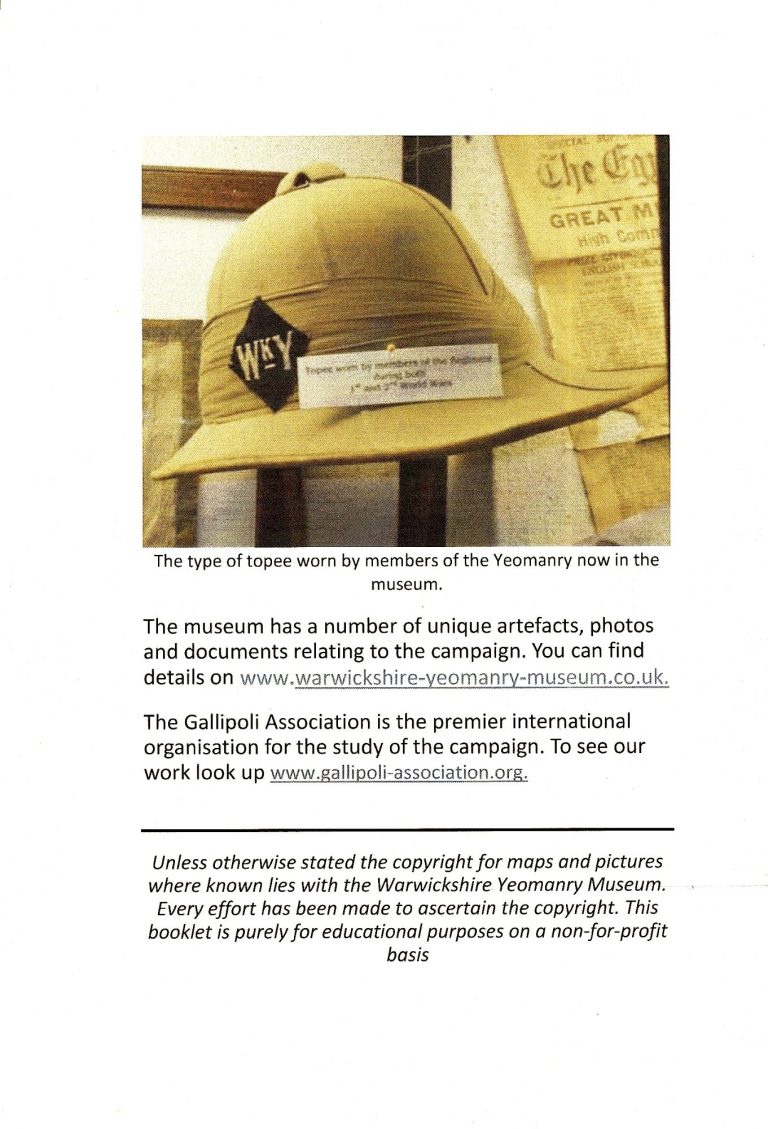
6
Title
Lorem ipsum dolor sit amet, consectetuer adipiscing elit. Aenean commodo ligula eget dolor. Aenean massa. Cum sociis natoque penatibus et magnis dis parturient montes, nascetur ridiculus mus.

7
Title
Lorem ipsum dolor sit amet, consectetuer adipiscing elit. Aenean commodo ligula eget dolor. Aenean massa. Cum sociis natoque penatibus et magnis dis parturient montes, nascetur ridiculus mus.
8
Title
Lorem ipsum dolor sit amet, consectetuer adipiscing elit. Aenean commodo ligula eget dolor. Aenean massa. Cum sociis natoque penatibus et magnis dis parturient montes, nascetur ridiculus mus.
9
Title
Lorem ipsum dolor sit amet, consectetuer adipiscing elit. Aenean commodo ligula eget dolor. Aenean massa. Cum sociis natoque penatibus et magnis dis parturient montes, nascetur ridiculus mus.
10
Title
Lorem ipsum dolor sit amet, consectetuer adipiscing elit. Aenean commodo ligula eget dolor. Aenean massa. Cum sociis natoque penatibus et magnis dis parturient montes, nascetur ridiculus mus.