WW1 Mobilisation
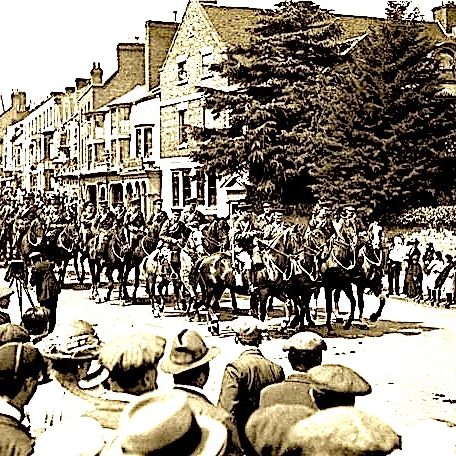
© The Warwickshire Yeomanry Museum
The Commencement of the Great War
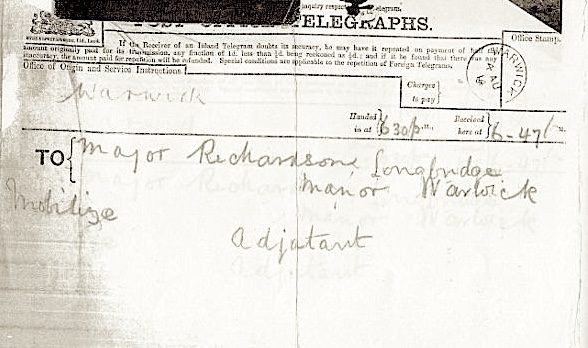
War began at midnight on the 4th August 1914, when the time for the reply to the British ultimatum expired but already that afternoon the Official Telegram had been received by the Secretary of the Territorial Force Association which read:
“MOBILISE 4th WARWICKS”
The message was immediately transmitted to the various Territorial Units and amongst them to the Warwickshire Yeomanry, through their Adjutant Captain E.H. STOCKER, to the respective Squadron Commanders.
Mobilization commenced on the 5th August and continued until 10th August, when the Regiment organised in three Service Squadrons (‘A’ Squadron being absorbed),
concentrated at Warwick.
© The Warwickshire Yeomanry Museum
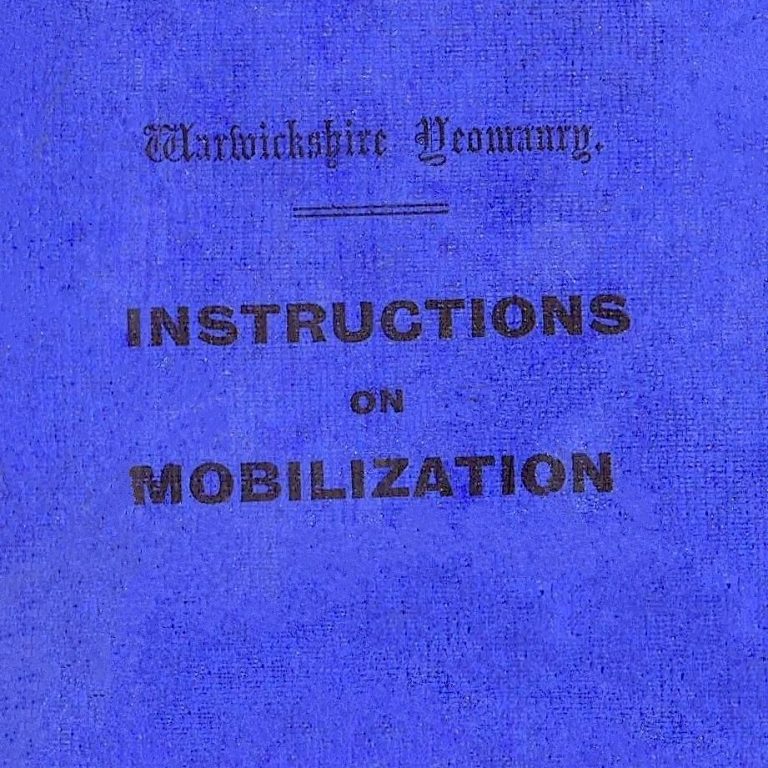
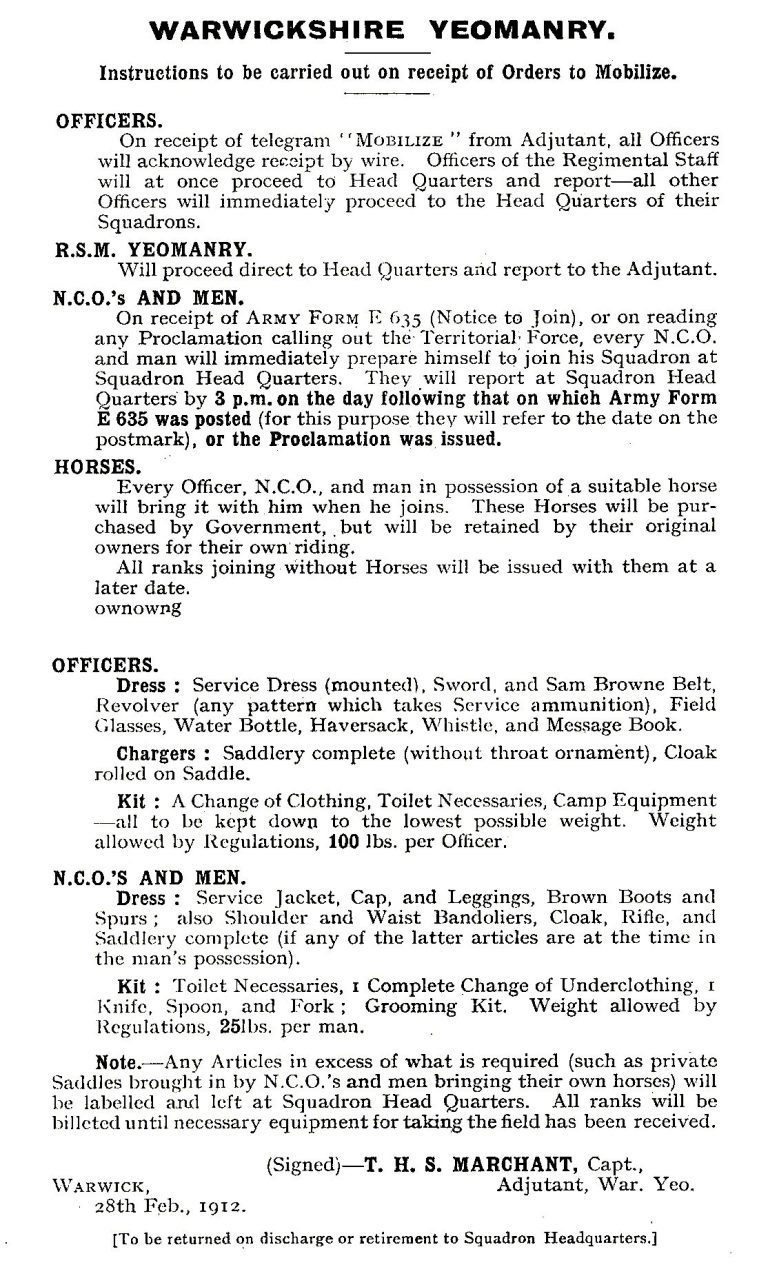
All men serving in the Warwickshire Yeomanry carried in their top pocket a little blue card ‘Instructions on Mobilisation’.
© The Warwickshire Yeomanry Museum
© The Warwickshire Yeomanry Museum
'A' Squadron mobilised on the 5th at Birmingham and were billeted in the City that night, but on the following day the Squadron was broken up, in
accordance with the scheme of mobilization - one third of the men transferred to each of the other three Squadrons.
‘B’ Squadron mobilised at Warwick on the 5th and were billeted in the Town - the time was spent collecting horses for the Brigade Headquarters including daily drills in Warwick Park.
'C’ Squadron mobilised at Coventry on the 5th, horses were collected, transport purchased
locally and saddlery fitted. They arrived in Warwick on the 10th August.
‘D’ Squadron mobilised at Stratford-upon-Avon, they arrived in Warwick on the 10th.
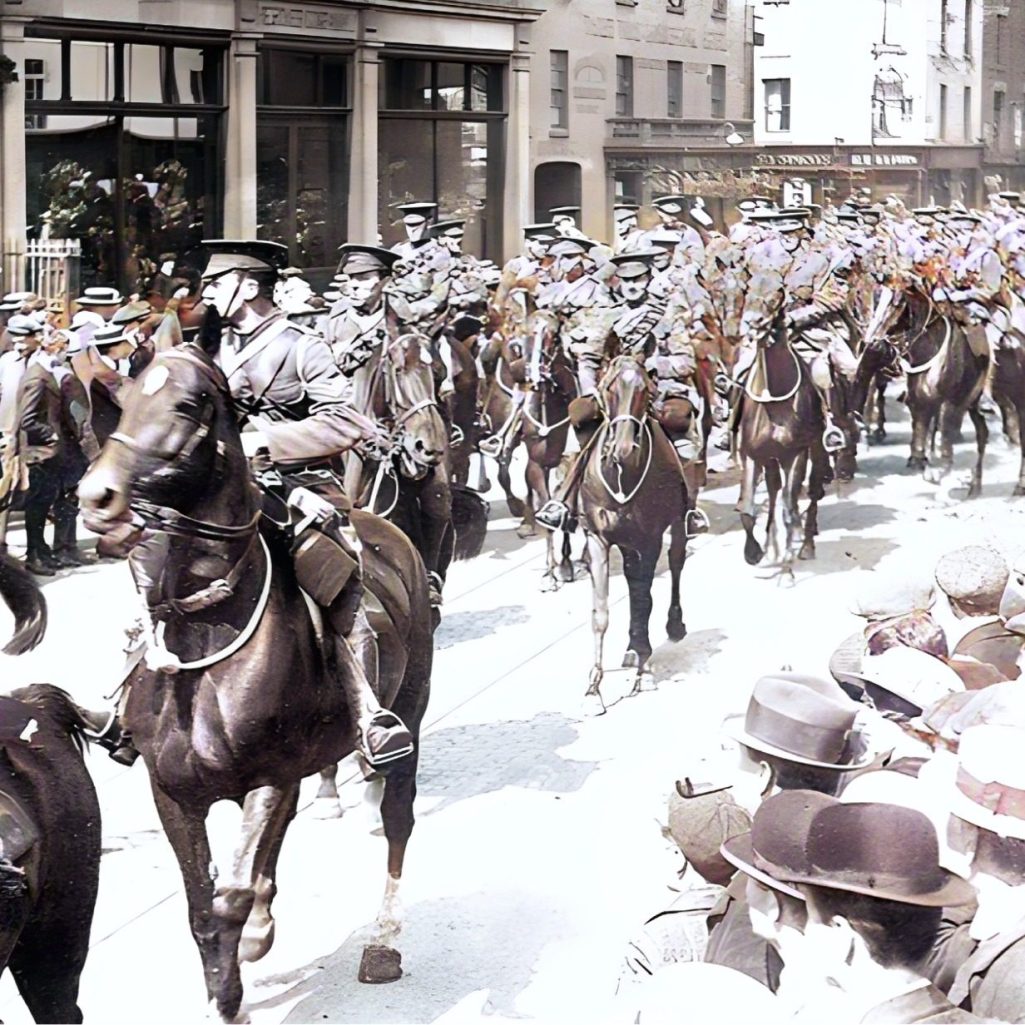
© The Warwickshire Yeomanry Museum
Postcard image 'C' Squadron leaving Coventry 10 August 1914.
On completion of mobilization the three Service Squadrons with Headquarters Staff paraded on Warwick Common on the 10th.
On the 12th August the Regiment assembled in Shire Hall, Warwick – a very large majority of the men volunteered for service.
The Brigadier having received equally satisfactory reports from the Worcester and Gloucester Yeomanry (the other Regiments in the Brigade) wired the War Office that the Brigade had willingly responded to the appeal.
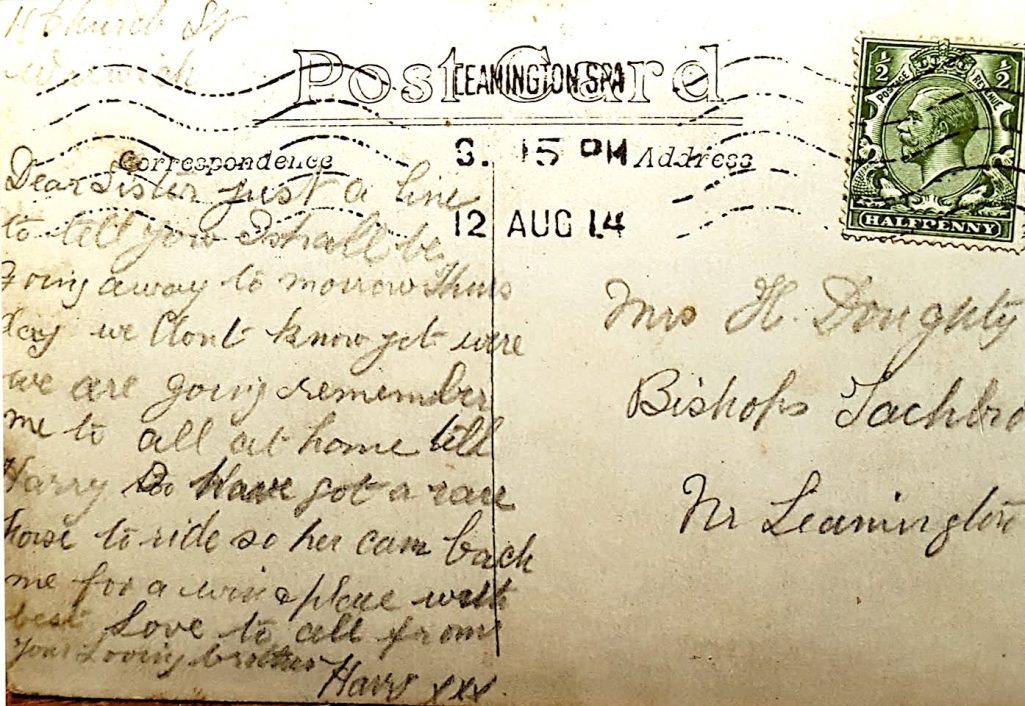
© The Warwickshire Yeomanry Museum
Many of the men are billeted in houses in the town as evidenced by this postcard image which was posted at 8.15pm in Warwick on the 12th August 1914.
In the top left-hand corner of the reverse of the card are the words ‘11 Church Street Warwick’ – the message reads 'Just a line to tell you I shall be going away tomorrow. We don’t know yet were we are going remember me to all at home...........’ Harry.
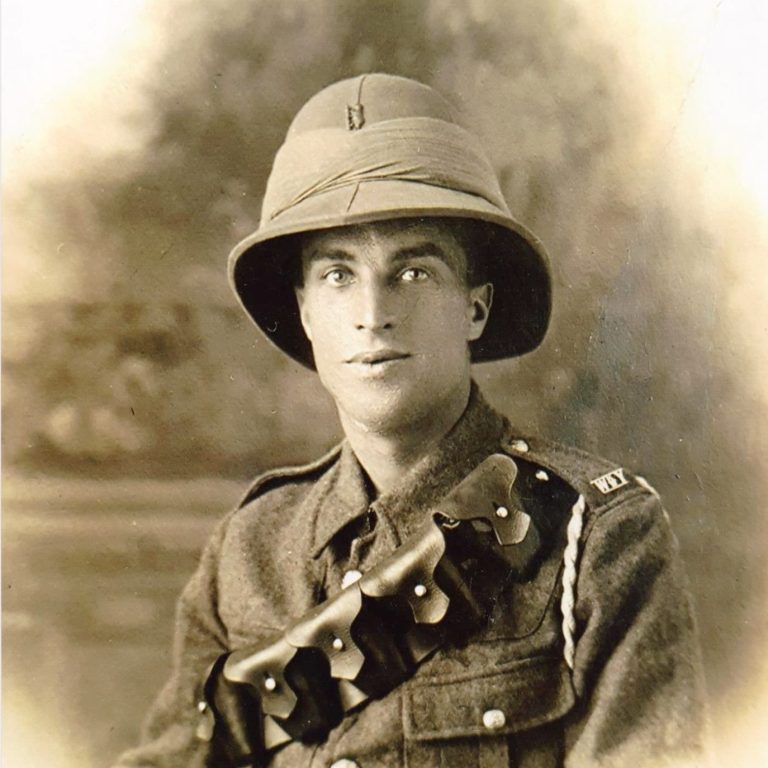
© The Warwickshire Yeomanry Museum
Shown on the left is
1830 Pte Harry FOX
‘B’ Squadron 1/1st
Warwickshire Yeomanry
who enlisted in 1913 and was in the Warwickshire Yeomanry Band.
Harry FOX agreed on the 12th August 1914 to serve overseas.
His was to be a long war - he had the misfortune to be killed in France on 17th October 1918 when serving with the 100th (Warwick and South Nott’s Hussars) Machine Gun Battalion.
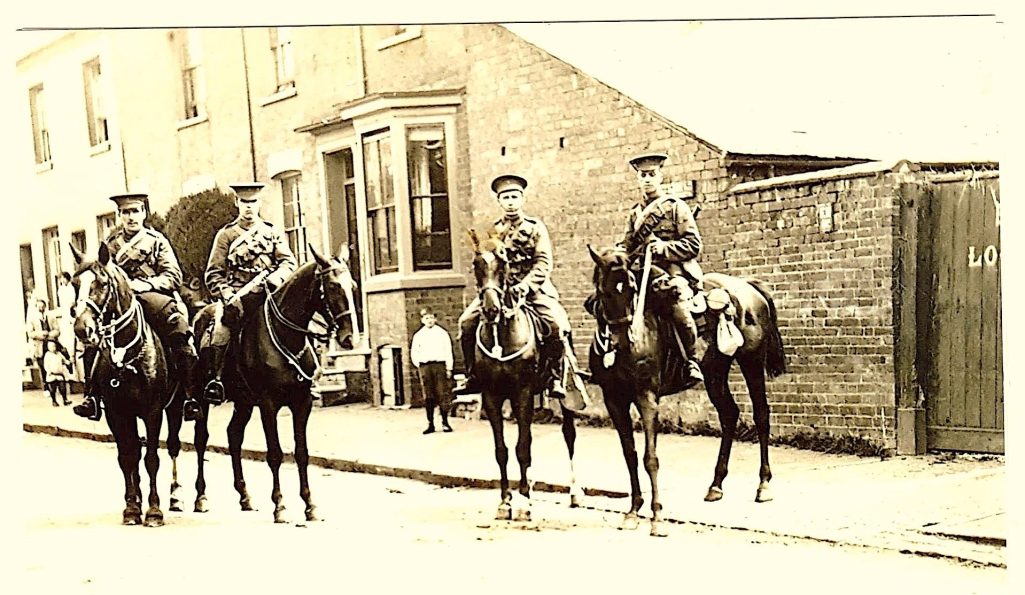
© The Warwickshire Yeomanry Museum
The four young men above are Warwickshire Yeoman one of whom is Harry Fox in what we believe may well be Hampton Street or Friar Street, Warwick. It’s difficult to identify the precise location as many of the houses in that area have since been demolished.
Tibbets
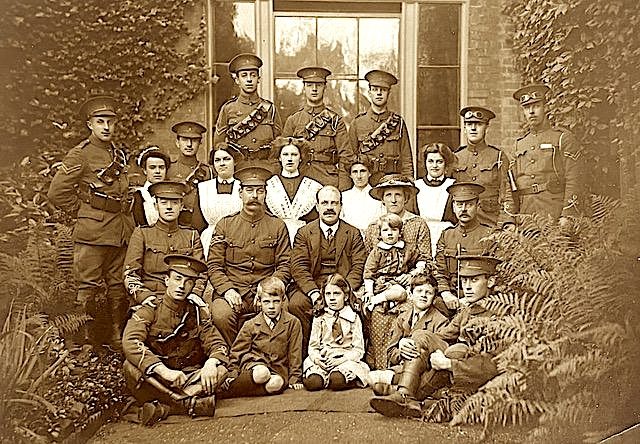
Many of the men were billeted in houses in the town as evidenced by the enclosed photograph and supporting historic document, signed by all 12 Warwickshire Yeoman billeted at 21 Jury Street, Warwick. Little did they realise that this thank you letter together with the group photo taken in the garden of 21 Jury Street on the 13 August 1914 would be the subject of research some 111 years later.
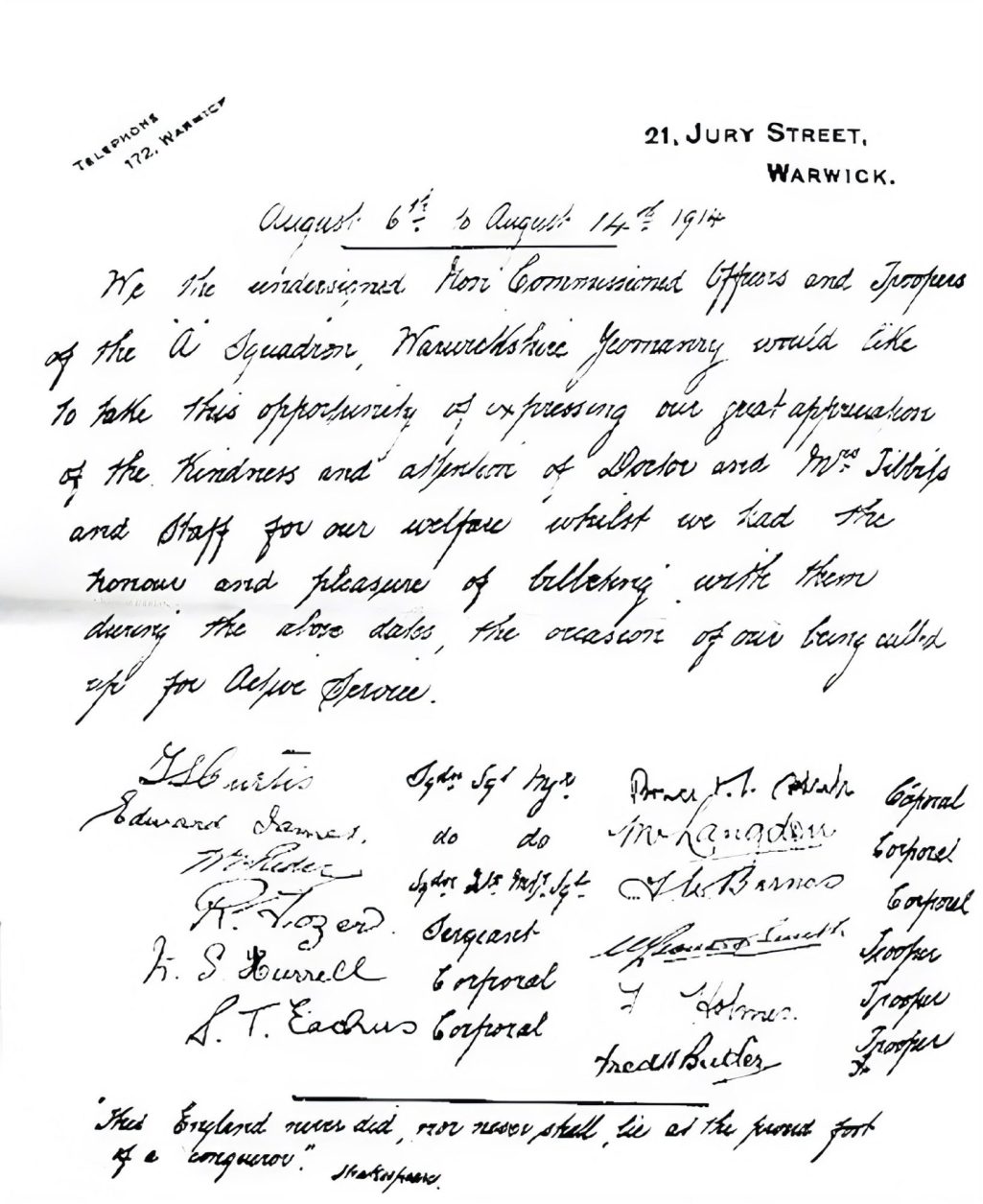
© Anthony TIBBITTS.
1446 Cpl Norman S. HURRELL enlisted 15.2.1908, he served with the Warwickshire Yeomanry Signal Troop and later ‘C’ Squadron he had the misfortune to die of wounds on the Hospital Ship ‘Nevassa’ on 23 August 1915. Eleven survived and are the subject of ongoing research.
On the 13th August the Regiment entrained at Milverton Railway Station and arrived at Bury St Edmunds on the 14th, HQ is established at Fornham House and the remainder of the men and officers in the neighbourhood.
The Gloucesters and Worcesters reached Warwick on the 11th and followed to Bury later.
A period of intensive training commenced and on the 24th August the Regiment was
inspected by General ALDERSON at Livermere Park.
On the 29th August they left for Bungay, bivouacking at Scole. They were then ordered to Norwich and spent the night of the 30th August in a field outside the city.
On the 31st August they entrained for Newbury and went into camp on the Racecourse.
Here the whole Brigade assembled comprising Warwick, Gloucester ad Worcester Yeomanry Regiments, with the Warwickshire Royal Horse Artillery and together they formed the 1st South Midland Mounted Brigade.
© Anthony TIBBITTS.
Back Row: Cpl S.T. EACHUS, (not identified), Tpr. F. HOLMES.
Next Row: Cpl M. LANGDON, Signal Sgt. R. TOZER, Cpl. N.S. HURRELL, Cpl. F. BARNES.
Next Row: Maids – Lucy CASHMORE, Bessie STILES, Anne CLARKE, Alice COLE, Olive CHARLES.
Next Row seated: SQMS. W.E. RIDER, SSM T. S. CURTIS, Dr. H. TIBBITTS MA, Mrs Edith L. TIBBITTS with child, SSM. E. JAMES.
Front Row seated: Cpl B.V.I. WHEELER, Three TIBBITTS Children, (not identified).
Two have yet to be positively identified: Troopers W.L. SMITH and C.A. BUTLER.
Most of the men in this photograph served with the Signal Troop:-
Two were commissioned: BARNES (R.F.C.) and BUTLER (Bedfordshire Yeomanry).
Two were posted to the Royal Engineers: Euchus and HOLMES.
Sgt-Major JAMES was transferred to the 7th Royal Warwickshire Regiment on 7 August 1917.
The Museum Trustees place on record their grateful thanks to Anthony TIBBITTS for sharing this group photo with supporting letter.
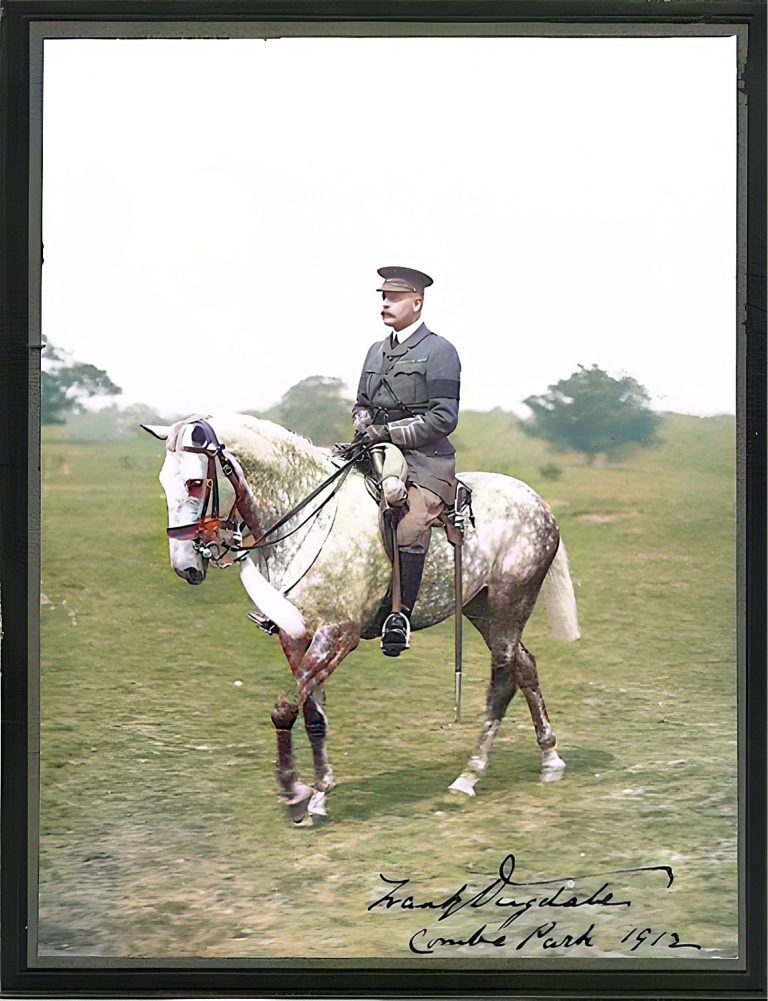
© The Warwickshire Yeomanry Museum
Colonel Frank Dugdale at Combe Park
30th August to 30th September 1914
All the Regiments, with the addition of the Warwickshire Royal Horse Artillery and together they formed the 1st South Midland Mounted Brigade. While in camp at Newbury a very
serious stampede of horses occurred, resulting in many being badly injured.
On the 31st August 1914 the War Office, authorised the County Associations to form Reserve Units for each Service Unit of the Territorial Force, 60% of which had volunteered for
general service, to be raised and trained at the original Headquarters of the Unit. Officers Commanding being ordered to submit nominations for commissions in these reserve units for consideration.
Lt.-Colonel R. CHARTERIS having already returned to the Headquarters at St. Johns, Warwick for the purpose, with the assistance of Lord WILLOUGHBY de BROKE, then
commenced recruiting for the 2/1st Warwickshire Yeomanry. Captain F.FLEMING (formerly Capt. 6th Dragoon Guards) was appointed Adjutant (21.9.14).
Officers were gazetted as listed in Chapter v11 of ADDERLEY’s ‘The Warwickshire Yeomanry in the Great War.’
On the 30th September 1914 Lt.-Colonel F. DUGDALE 1/1st Warwickshire Yeomanry was succeeded by Lt. Colonel T.A.WIGHT-BOYCOTT (Staffordshire Yeomanry). DUGDALE then undertook the formation of the 2/1st Warwickshire Yeomanry.
The Officer’s Mess was established at the Woolpack Hotel, Warwick. Recruits soon began to come in and, after being subjected to a preliminary riding test the best were enrolled. Foot drills and recruit training were carried out at Headquarters and on the Common.
As horses were at first not supplied, a mixed lot of ponies and hunters were collected by Major EMMET and a Riding School was established at Warwick Racecourse.
On the 3rd September 1914 there was a Field Day and Scheme under the direction of
Brig-General WIGGIN followed by an Inspection by General Sir Ian HAMILTON.
Throughout September Brigade and Regimental Training were carried out on a daily basis.