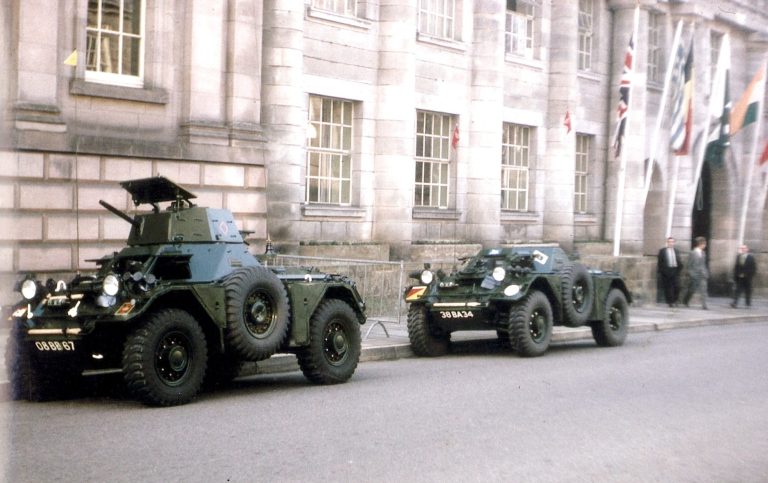
Warwickshire Yeomanry Unveiled!
The Warwickshire Yeomanry
Read the Short History
Below
Boer War - Imperial Yeomanry
WW1 Machine Guns In France
WW2 - El Alemein Tank Battle
WW1 - Cavalry Charge at Huj
Outline History of the Warwickshire Yeomanry
1794 - 1956
Introduction
The Warwickshire Yeomanry was established in 1794 as a response to the threat of French invasion during the Napoleonic Wars. Throughout its history, the
Regiment's members pursued
ordinary civilian careers during peacetime, dedicating their spare time to military training on
weekends, evenings, and during an annual two-week camp. The
Regiment distinguished itself in the Boer War and in both World Wars. In 1957, it amalgamated with The Queen’s Own Worcestershire Hussars, marking the end of an era but ensuring the continuation of its proud traditions.
How the Regiment Began
Amidst fears of a Napoleonic invasion in 1794, the British Government sought to strengthen the nation's internal defence. On 3rd March, the House of Commons discussed the need for additional cavalry, composed of 'Gentlemen and Yeomanry'. Consequently, the Lord Lieutenants were instructed to raise new cavalry units. The Warwickshire Regiment of Fencible Light Dragoons was formed through public subscription, commanded by the Earl of Warwick. The Regiment was noted for its fine horses,
considered superior to most light dragoon
Regiments it was disbanded after the Napoleonic Wars. The remaining funds were used to create a Corps of Yeomanry Cavalry
under the Earl of Aylesford, initially
comprising four troops, each with 54 men
including officers.
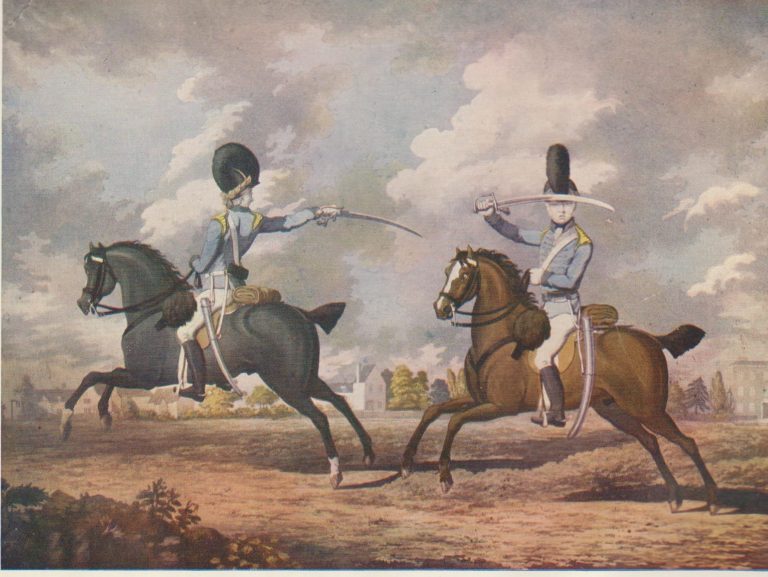
Gentlemen and Yeomanry
On 23rd April 1794, a public meeting took place at Shire Hall in Warwick to organise means for enhancing the internal defence and security of the United Kingdom. This meeting, reported in Aris’ Birmingham Gazette, led to the official formation of the Warwickshire Regiment of Fencible Light Dragoons which was disbanded shortly after the Napoleonic Wars. Four troops of Yeomanry Cavalry, under the command of the Earl of Aylesford, were also raised. By 1797, these troops became a formal Regiment, positioning the Warwickshire Yeomanry second in seniority after the Royal Wiltshire Yeomanry. Over the following years, the Regiment was mobilised several times to support civil authorities during riots and disturbances across Warwickshire.
The Boer War 1899-1902
Originally restricted to service within Warwickshire and
neighbouring counties, the Regiment’s terms were altered in 1900 to allow for overseas deployment during wartime. Two
squadrons volunteered for active service in the Boer War, serving as Imperial Yeomanry in South Africa with notable success. The Warwickshire Yeomanry Museum houses extensive archives from the South African campaign, including diaries, photographs, newspaper clippings, letters, and other
documents. The Anglo-Boer War was a complex conflict, and further information can be found at www.angloboerwar.com.
Warwickshire Imperial Yeomanry in South Africa
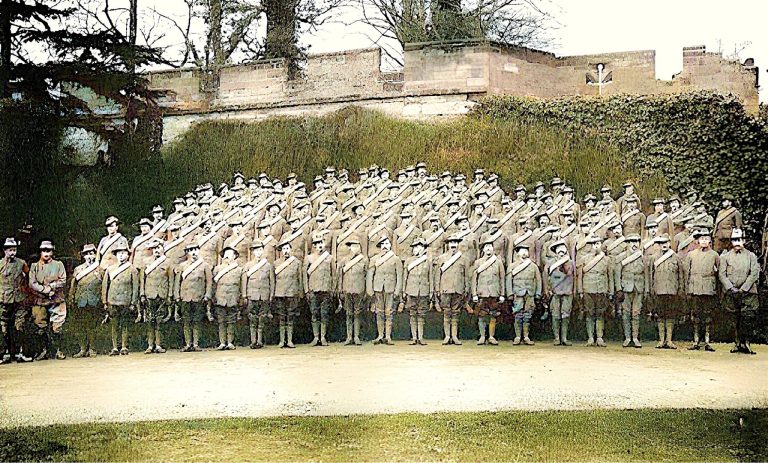
The Imperial Yeomanry was created by Royal Warrant on 24th December 1899, with each Yeomanry Regiment providing a volunteer squadron, later grouped into battalions. The Warwickshire Yeomanry’s squadron became the 5th Company, 2nd Battalion Imperial Yeomanry, comprising five officers and 116 other ranks, and departed for South Africa on SS Lake Erie on 1st February 1900. At Kheis Drift on 25th May 1900, Major Orr-Ewing and two other ranks were killed while aiding wounded comrades, and ten more were wounded. A second contingent of 146 men was sent to replace those lost to illness, wounds, or death. The 5th Company
participated in the pursuit of General de Wet in spring 1901 and returned home to a hero’s welcome in Warwick Market Square in June 1901. The 103rd Company (Warwickshire), also part of the 2nd Battalion Imperial Yeomanry, served in South Africa between 1901 and 1902. For further accounts, see ‘With the Warwickshire Yeomanry in South Africa’ by Meynell Hunt (1902) and ‘The History of the Warwickshire Yeomanry Cavalry’ by The Hon H.A. Adderley (1912).
1902 - 1914
Following Queen Victoria’s death in 1901, the Regiment played a
significant role in her funeral
procession. In 1902, a detachment attended King Edward VII’s
coronation. The Territorial and Reserve Forces Act of 1908
established the Territorial Army, grouping the Yeomanry Regiments of Gloucestershire, Worcestershire, and Warwickshire, along with the newly formed Warwickshire Royal Horse Artillery Battery, into the 1st South Midlands Brigade, with headquarters at 12 Northgate Street, Warwick.
The Great War
1914 - 1918
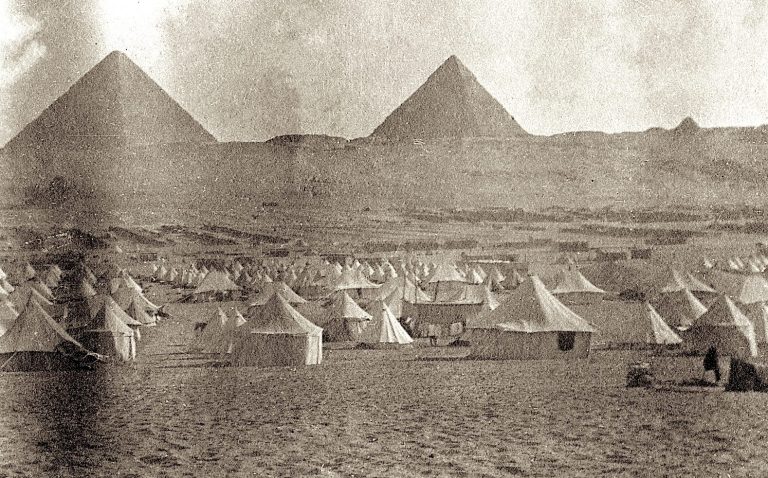
During the First World War, the Warwickshire Yeomanry served with
distinction at Gallipoli and were involved in General Allenby’s campaign in Palestine. Both the Warwickshire Yeomanry and the Queen’s Own Worcestershire Hussars are featured in Lady Butler’s painting depicting the last classic unsupported cavalry charge
of the Great War to capture guns, known as the Affair at Huj. In the latter part of 1918, the Regiment moved to France, serving as a Machine Gun Battalion.
Gallipoli
In August 1915, the 1st Mounted Brigade was sent to Gallipoli as
dismounted infantry, with a quarter of the 1st/1st Warwickshire Yeomanry remaining in Alexandria to care for the horses. They landed at Suvla Bay and participated in the
attack on Chocolate Hill,
remaining in action for four months before being recalled to Alexandria.
Palestine
In March 1917, British forces launched a
major offensive into Palestine against the Turks, suffering heavy casualties in the first two attempts to break through at Gaza. General Sir Edmund Allenby was appointed to lead the campaign, reorganising his forces and increasing their strength to nearly 90,000, Including the Desert Mounted Corps. On 31st October 1917, Allenby broke through Turkish defences at Beersheba, and by 9th December, Allied troops entered Jerusalem. The campaign featured British and Indian troops, with the cavalry playing a vital role by exploiting the open terrain to pursue the retreating Turks through the Sinai, Lebanon, and Syria.to Alexandria.
The Affair at Huj – 8th November 1917
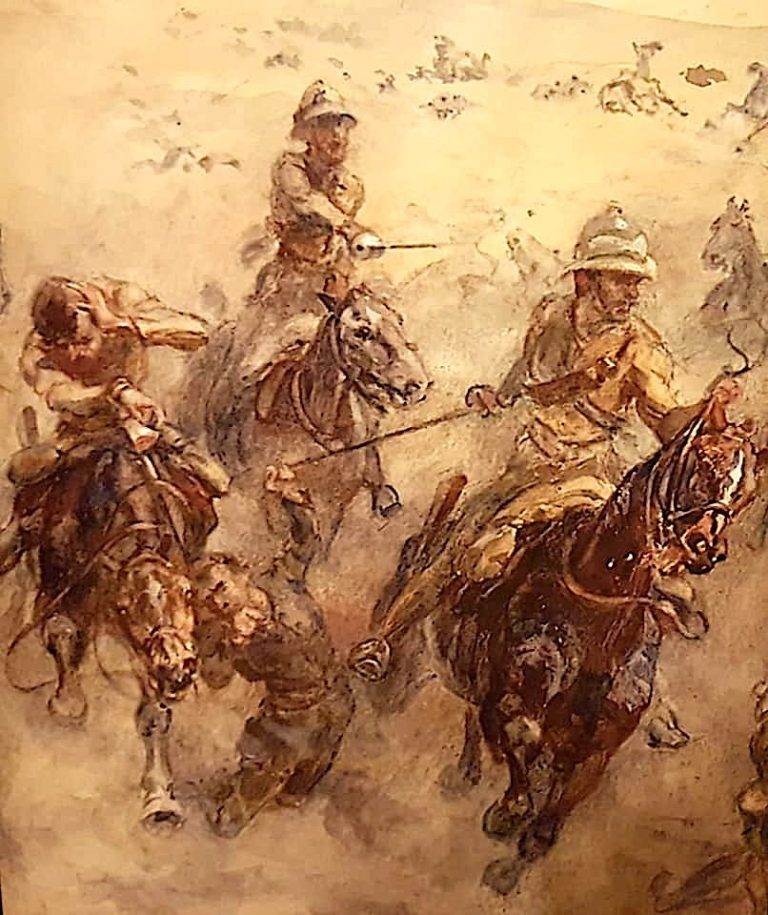
The Affair at Huj is commemorated in Lady Butler’s watercolour,
depicting 1.5 squadrons each of Warwickshire Yeomanry and Queen's Own Worcestershire Hussars in the last classic
unsupported cavalry charge
(arme blanche) of the British Army to capture guns against artillery. Of the 190 Yeomen involved, 36 were killed, 57 wounded, and 110 horses lost. The charge resulted in the
capture of nine field guns, three 5.9-inch howitzers, and three
machine guns, routing a Turkish
brigade of over 2,000 men and
sowing chaos in their rear lines. Major Oscar Teichman, Medical Officer for the Worcestershire Yeomanry, later wrote that the Charge at Huj, had it occurred in a lesser war, would have become
legendary like Balaclava. Though one of many acts of gallantry in the Great War, it stands out for its
unmatched bravery and
demonstrated the power of
mobility in attack.
Between the Wars
1920 - 1939
The Regiment was reformed as a cavalry unit in 1920, with the addition of a heavy machine gun troop. As the prospect of war loomed, the Regiment achieved full war establishment by 1st May 1939.
The Second World
War 1939 - 1945
In January 1940, the Regiment was sent to the Middle East as part of the 1st Cavalry Division. During March and April 1941, they
relinquished their horses and
converted to motorised infantry, serving in Iraq, Syria, and Persia. Returning to Palestine in October 1941, they transitioned to a tank Regiment, later fighting with
distinction at El Alamein in October and November 1942.
El Alamein
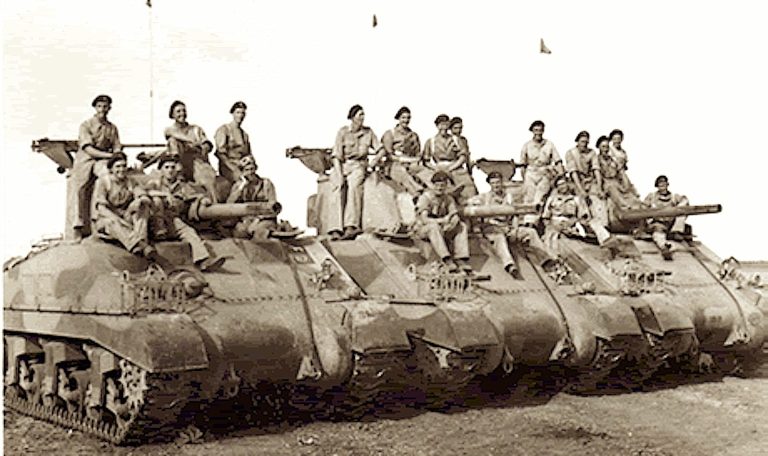
The Battle of El Alamein commenced on 22nd October 1942. The Warwickshire Yeomanry’s role, described in the Regimental history ‘Yeoman Yeoman’, was marked by
exceptional bravery. On the night of 22nd of October a heavy barrage signalled the start of the battle. The Yeomanry fought through minefields in support of the New Zealanders, reaching Miteriya Ridge but were delayed by additional mines. On 24th October, a gap was cleared, allowing them to advance and attack the enemy flank. Ordered to return and hold the ridge, they endured three days of intense combat before preparing for a second attack. On 1st November, the Regiment embarked on a critical offensive described by General Montgomery as a "do or die" mission. At 01:05 on 2nd November, a four-hour artillery barrage began. Despite being delayed by minefields and suffering heavy losses—only seven tanks of fifty-two remained
operational by 10:00—the attack succeeded. The advance resumed two days later, and by 8th November, Rommel had withdrawn to Tunis, where the Germans were eventually expelled from Africa. For its valour, the
Regiment was awarded the unique honour of the New Zealand Fern Leaf, to be displayed on its vehicles, by General Bernard Freyberg VC.
Italy
After El Alamein, the Regiment spent 15 months refitting and
training in Egypt and Palestine. On 4th May 1944, they joined the Italian campaign, landing at Taranto. They advanced through the
challenging terrain to Cassino, and after its fall, pursued the enemy through Rome and into the hills beyond Orvieto and Lake Trasimeno. The Regiment was
repeatedly engaged in action, fighting with determination and
courage. In November 1944, after nearly five years of continuous
service, they arrived at Livermore Camp near Bury St Edmunds as a Tank Training Regiment.
After the Second World War 1946 - 1956